

Comparing the Volkswagen Atlas Cross Sport to the Competition
2026 Volkswagen Atlas Cross Sport at Sisbarro VW
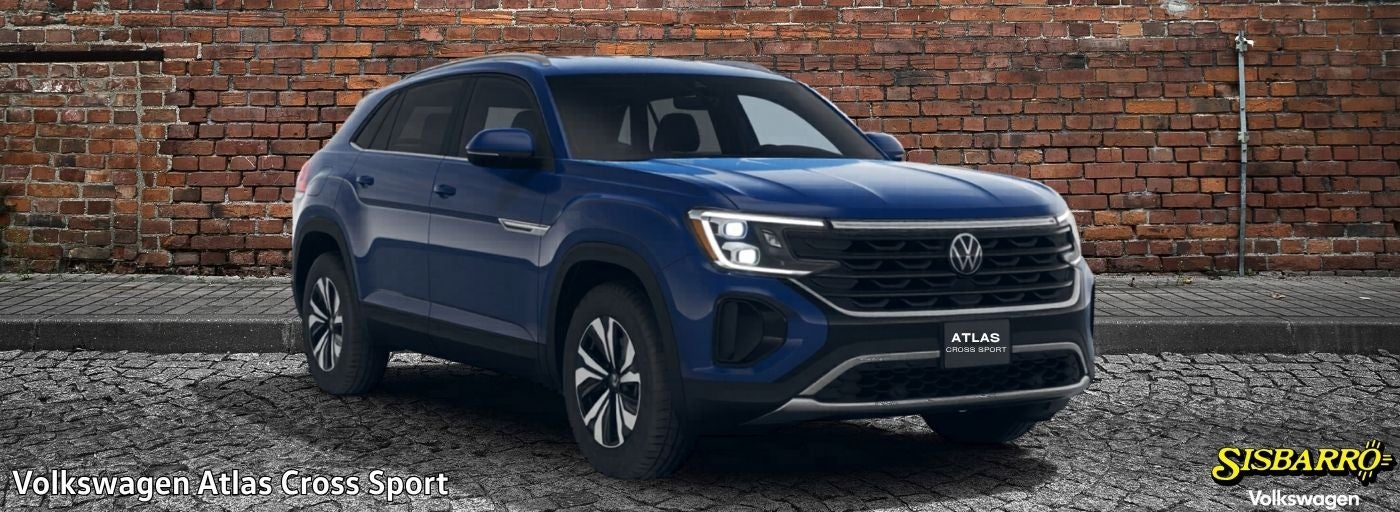
Four years after the Atlas's 2017 launch, Volkswagen introduced a shorter, five-passenger version called the Atlas Cross Sport. Compared with the Atlas, it is two inches shorter and two inches lower, and it features a sloping rear hatch that gives it a sporty look. Originally powered by a V6 engine, the model now uses a turbocharged 2.0-liter inline-four engine that produces 269 horsepower and 273 lb-ft of torque. Though shorter than the Atlas, the wheelbase was retained and is longer than most models in this segment.
Like many Volkswagen models, the Atlas Cross Sport is the only European-designed mid-size crossover from a non-luxury brand. Atlas Cross Sport is available in SE, SEL, SEL Premium R-Line, and SEL Premium R-Line Black trims. Only the SE offers standard front-wheel drive (FWD), and optional all-wheel drive (AWD); all other trims come with standard AWD.
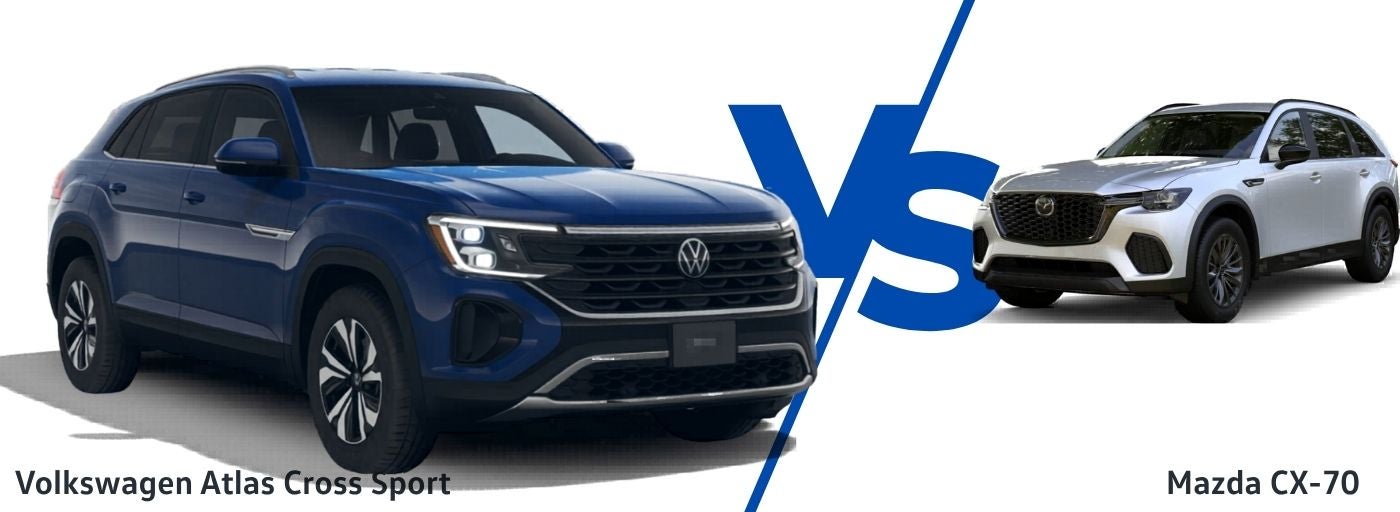
Atlas Cross Sport vs. Mazda CX-70
The CX-70 is a recent entry in the mid-size 2-row crossover segment, first introduced in the 2024 model year. Most models in this segment are derived from their brand’s 3-row crossover, but many, like the Atlas Cross Sport, have a unique body, generally from the front doors rearward, that gives the model a more aggressive profile. Not so with Mazda’s CX-70, which is simply the CX-90 without a third row.
The CX-70 also differs from most in this segment by using a rear-wheel-drive platform. Its turbocharged inline-6 engine and transmission using a wet clutch instead of a torque converter are also departures from its competitors. The CX-70 is available as a plug-in hybrid, though the non-hybrid models will be used for this comparison.
- The starting MSRP of $38,300 for the Atlas Cross Sport is significantly less than the CX-70’s starting MSRP of $42,250.
- Though the CX-70 has better fuel economy, it requires premium fuel, unlike the Atlas Cross Sport, which uses regular fuel, a difference that can add up at every refueling.
- With its bespoke body style, the Atlas Cross Sport has a more aggressive profile than the 3-row wagon-like CX-70.
- Rear passengers have an inch more legroom in the Atlas Cross Sport (40.4 vs. 39.4).
- Particularly useful when seating three across, the Atlas Cross Sport has considerably more hip room (58.0 vs. 55.5 inches) and rear shoulder room (60.6 vs. 58.1 inches).
- Atlas Cross Sport has a little more cargo room behind the rear seat (40.3 vs. 39.6 cu.ft) and with the seats folded (77.8 vs. 75.3 cu.ft).
- Volkswagen offers a superior warranty, with a 4-year/50,000-mile basic warranty compared to Mazda’s 3-year/36,000-mile warranty. The corrosion warranty for the Atlas Cross Sport is two years longer than the CX-70’s (seven vs. five years).
- Mazda does not offer two years of complimentary maintenance, as Volkswagen does for the Atlas Cross Sport.
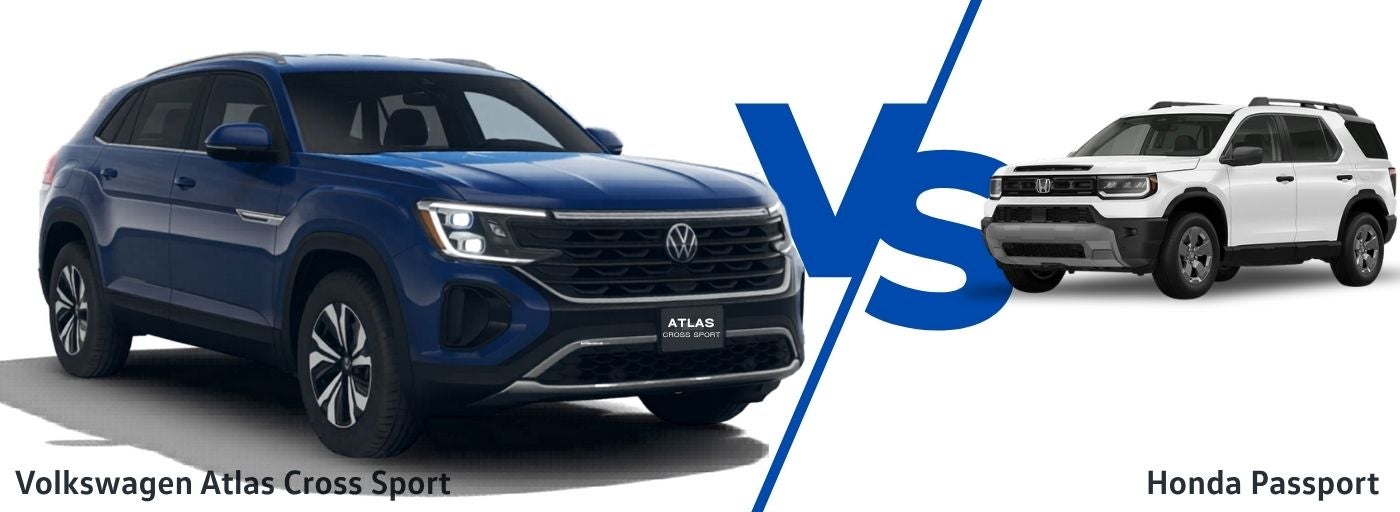
Atlas Cross Sport vs. Honda Passport
Aside from the Honda-badged Isuzu-built Passport of the mid-90s, the current Honda Passport is similar to the VW Atlas Cross Sport in that it is a shortened five-passenger version of the brand’s third-generation three-row crossover. All models have standard AWD and are powered by a normally aspirated 3.5-liter V6 engine. The Passport is available in RTL and Trail Sport trims with upgrades for each.
- The entry price for the Passport is quite high at $44,950. That is about $4,750 more than the Atlas Cross Sport SE AWD.
- While the Passport has 11 more horsepower (269 vs. 280), the Atlas Cross Sport produces 11 more pound-feet of torque (273 vs. 262) at a far more accessible rpm (1,600 vs. 4,700).
- The Atlas Cross Sport has a higher payload (1,091 pounds vs. 948).
- Front passengers have almost an inch more legroom in the Atlas Cross Sport (41.7 vs. 40.9).
- Rear passengers have almost an inch more legroom in the Atlas Cross Sport (40.4 vs. 39.6).
- The AWD Atlas Cross Sport has slightly better highway fuel economy (20/26/23 mpg vs. 19/25/21 mpg).
- When leveled up to be price comparable to the entry-level Passport, the Atlas SE/Technology has several items the Passport EX-L does not, including:
- Second-row climate vents
- Heated steering wheel
- Dual-level center console
- Gesture infotainment controls
- Side-window sunshades
- Ventilated front seats
- Engine start, horn/light operation, lock operation, and vehicle location services on the smartphone app
- Trailer hitch and wiring harness
- Rain-sensing wipers
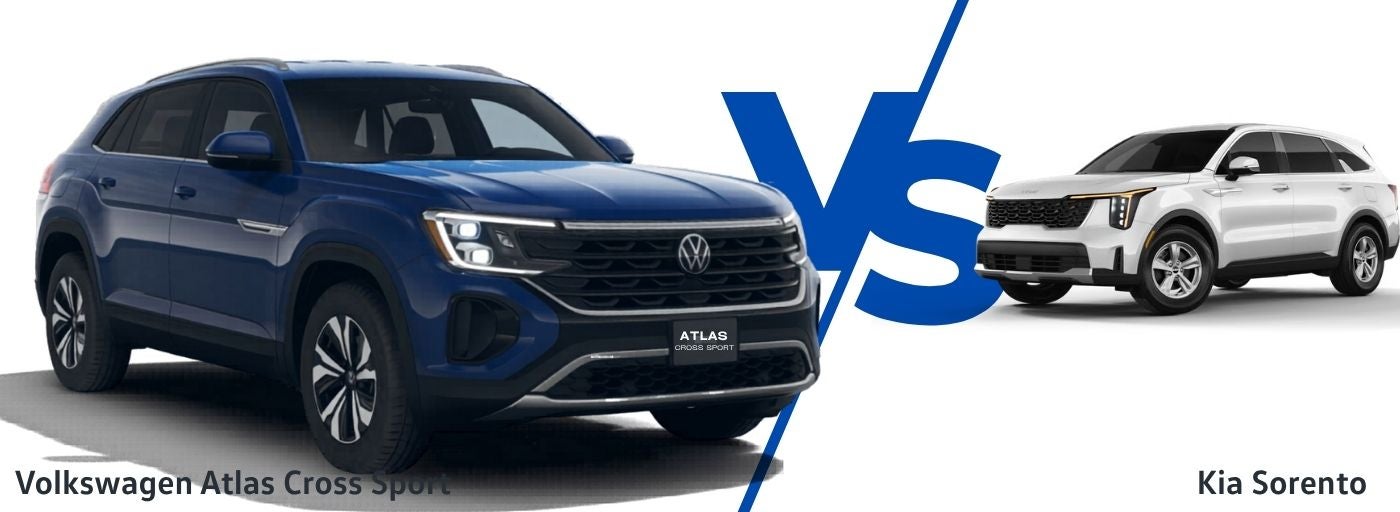
Atlas Cross Sport vs. Kia Sorento
Kia Sorento is the brand’s smaller three-row crossover. The current fourth-generation Sorento began in the 2021 model year, though a recent facelift brought it an all-new front-end design. The model is available with conventional gas, hybrid, and plug-in hybrid drivetrains. Unless otherwise specified, comparisons will be made with the non-hybrid Sorento EX 2WD, which is generally price-competitive with the Atlas Cross Sport SE 2WD.
- The Atlas Cross Sport has a considerably more powerful base engine with more horsepower (269 vs. 191) and more peak torque 273 vs. 181 lb-ft)
- The Atlas Cross Sport also delivers peak torque at a much more accessible engine rpm (1600 vs. 4000).
- Atlas Cross Sport has greater overall cargo capacity than the Sorento (77.6 cu ft vs. 75.5 cu ft).
- When off pavement, the Atlas Cross Sport has higher approach and departure angles than the Sorento (20.8º/25.1º vs. 18.1º/23.5º). Break-over angle is not available for the Sorento.
- Atlas Cross Sport has more shoulder room in the second row (60.6 vs. 58.1 inches).
- Atlas Cross Sport has more hip room in the second row (58.0 vs. 55.1 inches).
- The Sorento features standard second-row captain’s chairs, which can be nice unless you have a fifth passenger who will have to sit in the third row, which has only 29.6 inches of legroom.
- Standard features on the base Atlas Cross Sport that are not available or require a trim upgrade on the slightly more expensive Sorento EX include:
- Heated steering wheel
- Ventilated front seats
- Gesture infotainment controls
- Rain-sensing wipers
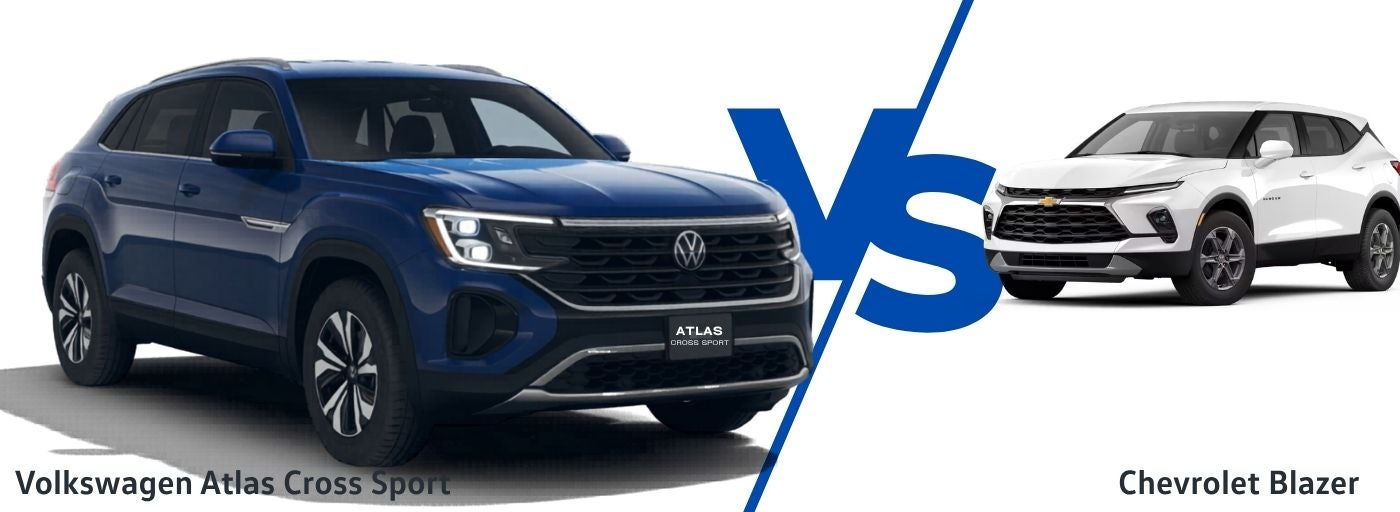
Atlas Cross Sport vs. Chevrolet Blazer
The Blazer is a far cry from the two-door truck-based SUV that originally bore the name. Instead, the Blazer has taken on the role of the Camaro of the mid-size crossover segment, even adopting that model’s exterior and interior trim elements. As such, unlike many models in this segment, the Blazer bears very little resemblance to its brand’s Traverse 3-row SUV. Most Blazers are powered by a 228-hp 2.0-liter turbocharged inline-4. The RS model also offers a 308-hp 3.6-liter V6. Besides the RS, the 2LT and 3LT trim levels complete the model line. All come standard with FWD, with AWD as an option for all trims.
- The Atlas Cross Sport has a more powerful base engine than the Blazer, with more horsepower (269 vs. 228) and more peak torque (273 vs. 258 lb-ft).
- Even the Blazer’s optional V6 engine doesn’t quite reach the torque of the Atlas Cross Sport, which also peaks at a much lower rpm (273 @ 1600 vs. 270 @ 5000).
- The Atlas Cross Sport also delivers peak torque at a much more accessible engine rpm (1600 vs. 4000).
- Atlas Cross Sport has greater overall cargo capacity than the Sorento (77.6 cu ft vs. 75.5 cu ft).
- Atlas Cross Sport has a larger center touchscreen than all Blazer models (12.0 vs. 10.2 inches).
- Legroom is more generous in the Atlas Cross Sport, with 41.7 inches in the front seat (vs. 41.0) and 40.4 inches in the rear seat (vs. 39.6).
- Atlas Cross Sport has considerably more cargo room than the Blazer, behind the second row (40.3 vs. 30.5 cu.ft) and with the rear seats folded (77.8 vs. 64.2 cu.ft).
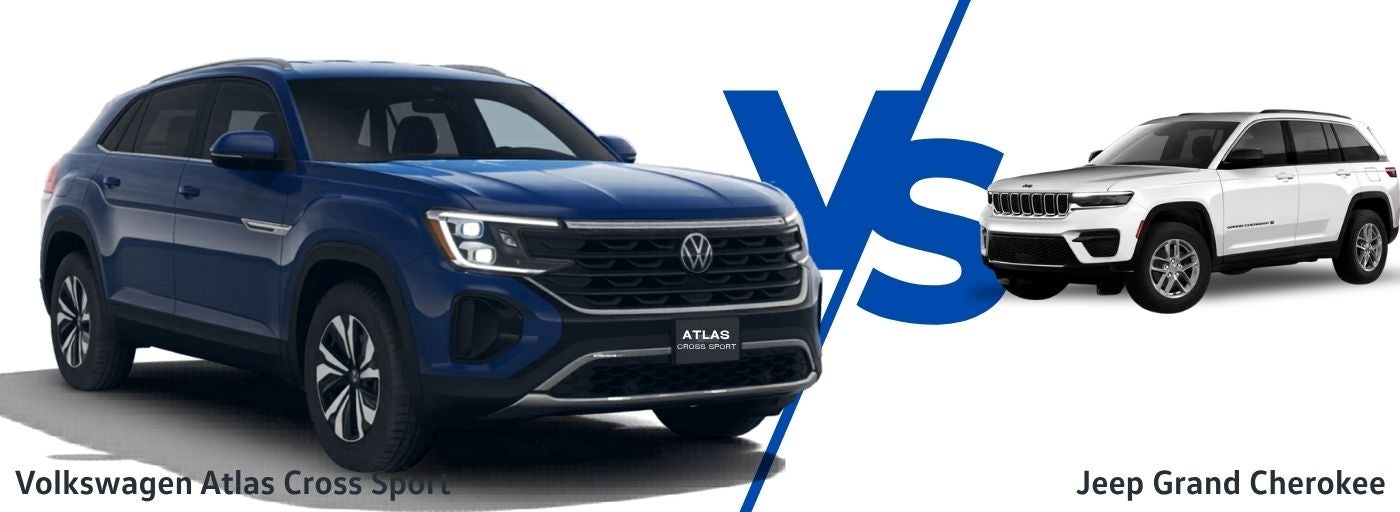
Atlas Cross Sport vs. Jeep Grand Cherokee
The Jeep Grand Cherokee is the Granddaddy of this segment, dating back to its original launch in 1992. Originally planned by the then-parent company, American Motors, as a replacement for the smaller Cherokee, the new Jeep owner, Chrysler, determined there was room for both models as the SUV market expanded. The current Grand Cherokee is in the fifth year of its fifth design generation. Bolstering Jeep’s off-road reputation, it is the only model in the segment with three four-wheel-drive systems and is one of the few with a rear-wheel-drive platform.
The Grand Cherokee is the opposite of the Blazer, offering a 3.6-liter V6 as the base engine with a 2.0-liter turbocharged engine as the upgrade. Filling the gap between this model and the full-size truck-based Wagoneer, there is a Grand Cherokee L with a 6.9-inch-longer wheelbase, to which they shoehorned a third row. This comparison of 2-row mid-size crossovers will focus on the regular-sized model.
- The Atlas Cross Sport and Grand Cherokee with the base engine trade power advantages. The Jeep has more horsepower (293 vs. 269), but the Atlas Cross Sport has more torque, which peaks at a much lower rpm (273 @ 1600 vs. 3.6L - 257 @ 4000).
- The FWD Atlas Cross Sport gets better fuel economy than the RWD Grand Cherokee with its base engine (21/27/23 vs. 19/26/22).
- The WWD Atlas Cross Sport gets better fuel economy than the AWD Grand Cherokee with its base engine (21/26/23 vs. 19/26/22).
- Atlas Cross Sport gives rear passengers noticeably more legroom than the Grand Cherokee (40.4 vs. 38.2 inches).
- There is more cargo room in the Atlas Cross Sport than in the Grand Cherokee, both behind the rear seats (40.3 vs. 37.7 cu.ft) and with the rear seats folded (77.8 vs. 70.8 cu.ft).
- Volkswagen provides a superior bumper-to-bumper warranty with a 4-year/50,000-mile basic warranty compared to Jeep’s 3-year/36,000-mile warranty.
- Jeep does not offer two years of complimentary maintenance, unlike Volkswagen, which does for the Atlas Cross Sport.
Compare 2026 Volkswagen Atlas Cross Sport to the Competition
 This page is best experienced in Landscape Mode.
| Large Two Row Crossover | Volkswagen Atlas Cross Sport | Mazda CX-70 | Honda Passport | Kia Sorento | Chevrolet Blazer | Jeep Grand Cherokee |
|---|---|---|---|---|---|---|
| Trims | 5 | 7 | 7 | 8 | 3 | 7 |
| Colors | 5 | 6 | 7 | 9 | 6 | 5 |
| Engine | 2.0-liter Turbo I-4 | 3.3-liter Turbo I-6 | 3.5-liter V6 | 2.5-liter 2.5-liter Turbocharged | 2.0-liter Turbo I-4 3.6-liter V6 | 3.6-liter V6 2.0-liter Turbo I-4 |
| Horsepower | 269 @ 5500 | 280 @ 5000 | 285 @ 6100 | 2.5L - 191 @ 6100 2.5T - 281 @ 5800 | 2.0L - 228 @ 5000 3.6L - 308 @ 6700 | 3.6L - 293 @ 6400 2.0L - 324 @ 6000 |
| Torque | 273 @ 1600 | 332 @ 2000 | 262 @ 5000 | 2.5L - 181 @ 4000 2.5T - 331 @ 1700 | 2.0L - 258 @ 4000 3.6L - 270 @ 5000 | 3.6L - 257 @ 4000 2.0L - 332 @ 3000 |
| Transmission | 8-speed auto | 8-speed auto | 10-speed auto | 8-speed auto | 9-speed auto | 8-speed auto |
| DriveTrain | FWD, AWD | FWD, AWD | AWD | FWD, AWD | FWD, AWD | 2WD, 4WD |
| Fuel Economy (Hwy/City/Combined) | FWD - 21 / 27 / 23 AWD - 21 / 26 / 23 | FWD - 24/ 28 / 25 AWD - 23 / 28 / 25 PHEV: 26 Comb, 32 EV | 19 / 25 / 21 Trailsport - 18 / 23 / 20 | 2.5L FWD - 23 / 31 / 26 2.5L AWD - 23 / 28 / 25 2.5T FWD - 20 / 29 / 23 2.5T AWD - 20 / 27 / 23 | 2.0L FWD - 22 / 29 / 25 2.0L AWD - 22 / 27 / 24 3.6L FWD - 19 / 26 / 22 3.6L AWD - 18 / 26 / 23 | 2.0L RWD - 22 / 29 / 25 2.0L AWD - 22 / 27 / 24 3.6L RWD - 19 / 26 / 22 3.6L AWD - 19 / 26 / 22 |
| Infotainment | 12 inches | 12.3 inches | 12.3 inches | 12.3 inches | 10.2 inches | 12.3 inches |
| Front Headroom | 39.4 | W/O Moonroof - 39.7 With Moonroof - 39.6 | 39.5 | 40.3 | W/O Sunroof - 39.8 With Sunroof - 38 | 39.9 |
| Front Legroom | 41.7 | 41.7 | 40.9 | 41.4 | 41 | 41.3 |
| Rear Headroom | 37.8 | W/O Sunroof - 39.3 With Sunroof - 38.4 | 40 | 2nd Row - 39.1 3rd Row - 36.8 | W/O Sunroof - 38.6 With Sunroof - 36.8 | 39.4 |
| Rear Legroom | 40.4 | 39.4 | 39.6 | 2nd Row - 41.7 3rd Row - 29.6 | 39.6 | 38.2 |
| Cargo Space Behind 2nd Row Seats | 40.3 | 39.6 | 44 | 38.5 | 30.5 | 37.7 |
| Cargo Space with Seats Folded | 77.8 | 75.3 | 83.8 | 75.5 | 64.2 | 70.8 |
| Base Price | $38,300 | $42,250 | $44,950 | $32,390 | $34,300 | $37,095 |
Why Buy from Sisbarro Volkswagen?
At Sisbarro Volkswagen, you will have an automotive experience unlike any other. You can find new Volkswagen inventory, including the Tiguan, Taos, GTI, Jetta, ID.Buzz, ID.4, and an unmatched collection of used car, truck, van, SUV, and crossover inventory at our dealership in Las Cruces, NM. Are you interested in leasing or financing your Volkswagen Atlas Cross Sport? The Finance Department at Sisbarro VW can help you find the right lease offer or finance solution that fits your budget. We cultivate relationships with many banks, lenders, and other financial organizations to provide you with great options in purchasing your new vehicle. In addition to the comprehensive factory warranty that comes with your new Atlas Cross Sport, we offer extended warranty and protection programs to safeguard your investment. Get the best deals and specials available to you on the Volkswagen Atlas Cross Sport. Our knowledgeable sales staff wants to help you find the perfect fit in a new Volkswagen or used car. We can’t wait to welcome you to the Sisbarro Volkswagen family and help you find your new car or used vehicle. Your support and customer service doesn’t stop after you sign your deal. The expert Service Department at our Volkswagen dealership in Las Cruces, NM is always ready to help with any repairs or maintenance you might need to keep your vehicle running perfectly. Our Express Service Lane will get you back on the road quickly when you need basic maintenance like an oil change or tire rotation. Would you like to make your new car all your own with personalized upgrades? Our well-stocked Parts Department has all of the Volkswagen genuine parts and accessories you need for the best customization of your vehicle. Make your car, truck, or SUV uniquely yours to fit perfectly in your lifestyle. We are eager to help you on your car buying and vehicle ownership journey. Visit us today at Sisbarro Volkswagen!

We’re sorry, availability of some equipment, options or features may be limited due to global supply issues affecting the auto industry. Please be sure to verify that the vehicle you purchase includes all expected features and equipment.