

Comparing the Volkswagen Tiguan to the Competition
2026 Volkswagen Tiguan at Sisbarro VW
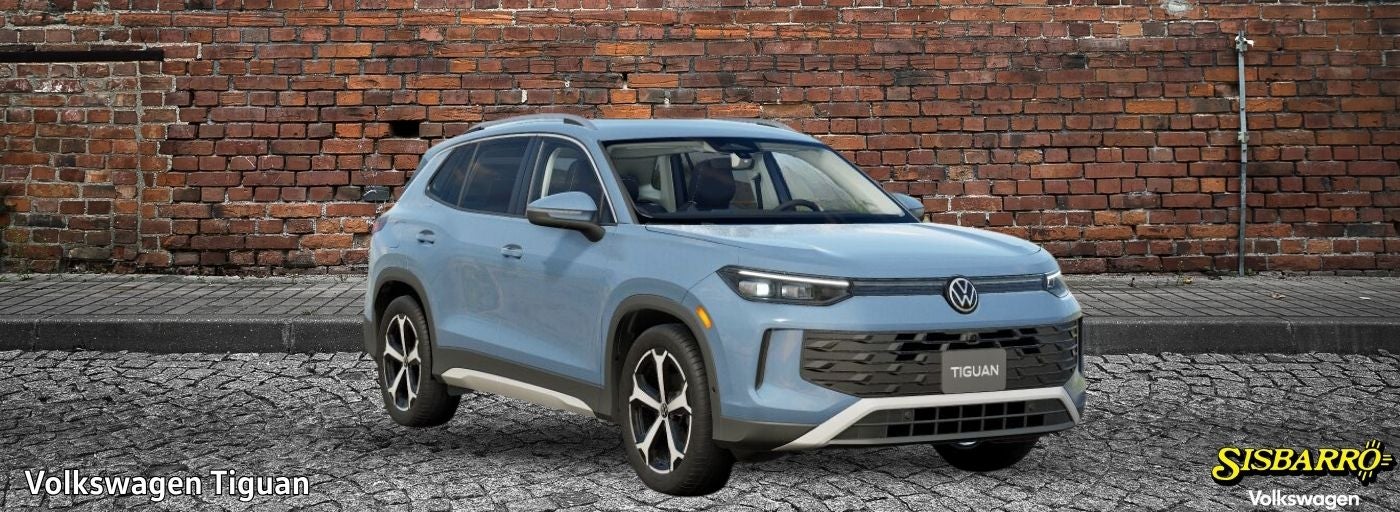
The Tiguan marks the entry of Volkswagen into the compact crossover segment, the best-selling automotive category in the U.S., and consequently the most competitive. Compact crossovers have effectively replaced sedans as the default family vehicle. Nearly all mainstream and luxury brands include a compact crossover in their model lineups. The appeal of this segment is clear, as these vehicles offer a compact, efficient size that makes them easy to maneuver in city traffic and parking lots, while also providing ample space to comfortably seat five people and a reasonable amount of cargo room. Most model lines offer all-wheel drive for enhanced on-road traction, either as an option or standard feature. The segment is mainly powered by 4-cylinder engines, both turbocharged and naturally aspirated, along with a few turbocharged 3-cylinder engines.
The Tiguan first came to North America as a 2009 model. It was on the smaller side of the segment until the 2018 second-generation design. The current third-generation Tiguan was launched for the 2024 model year. The Tiguan is powered by a 2.0-liter turbocharged inline-4 engine producing 201 horsepower and 207 or 221 lb-ft of torque, depending on whether the drivetrain is front-wheel drive (FWD) or has 4Motion all-wheel drive (AWD). The SEL-R Trim has a version of the GTI engine producing 268 horsepower and 258 lb-ft of torque. The 2026 model year included a weight reduction of about 170 pounds, improving the performance-to-weight ratio.
Like many Volkswagen models, the Tiguan is the sole non-luxury European choice in its segment.
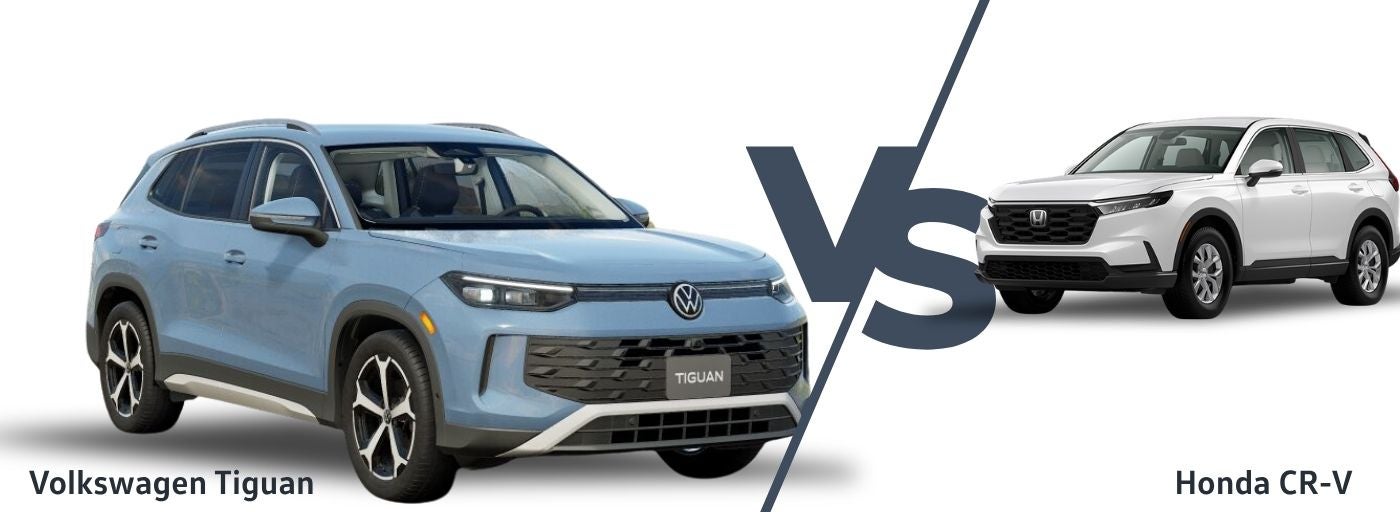
Tiguan vs. Honda CR-V
The Honda CR-V entered the U.S. market in February 1997. Now, in its sixth design generation, it is positioned between the HR-V and the Passport in terms of size and pricing. The CR-V is currently Honda’s best-selling vehicle. Non-hybrid models feature a 1.5-liter turbocharged inline-4 engine paired with a continuously variable transmission (CVT). This comparison focuses solely on the CR-V’s conventional drivetrain.
- The Tiguan offers more standard horsepower (201 vs.190), and more peak torque (207 or 221 vs. 179 lb-ft).
- Tiguan and CR-V trade small fuel mileage advantages, with the Tiguan having the advantage on the highway (34 vs. 33) while the CR-V is a little better in the city (26 vs. 28)
- The Tiguan runs on regular (87-octane) gas, while Honda recommends premium fuel (91-octane) for the CR-V.
- The CR-V’s engine is paired with a continuously variable transmission, while the Tiguan uses a more conventionally behaving 8-speed automatic.
- Important when seating three across, the Tiguan provides about an inch more rear hip room (53.7 vs. 52.6 inches).
- The Tiguan offers a bit more towing capacity (1,800 vs. 1,500 lb.)
- For a smoother and more stable highway ride, the Tiguan has a longer wheelbase (109.9 vs. 106.3 inches)
- The Tiguan offers the added flexibility of a 40/20/40 split rear seat, unlike the CR-V’s conventional 60/40 split. This setup allows two passengers to sit in the second row while longer, thinner items extend through the middle of the cargo area.
- The standard 12.9-inch center touchscreen of the Tiguan is considerably larger than the CR-V’s standard 9-inch screen or its optional 10.2-inch screen.
- The standard Tiguan offers one-touch activation for all four windows, while the CR-V limits this to the front windows only.
- The convenience of a dimming rearview mirror and heated side mirrors is standard on the base Tiguan but requires a trim upgrade for the CR-V.
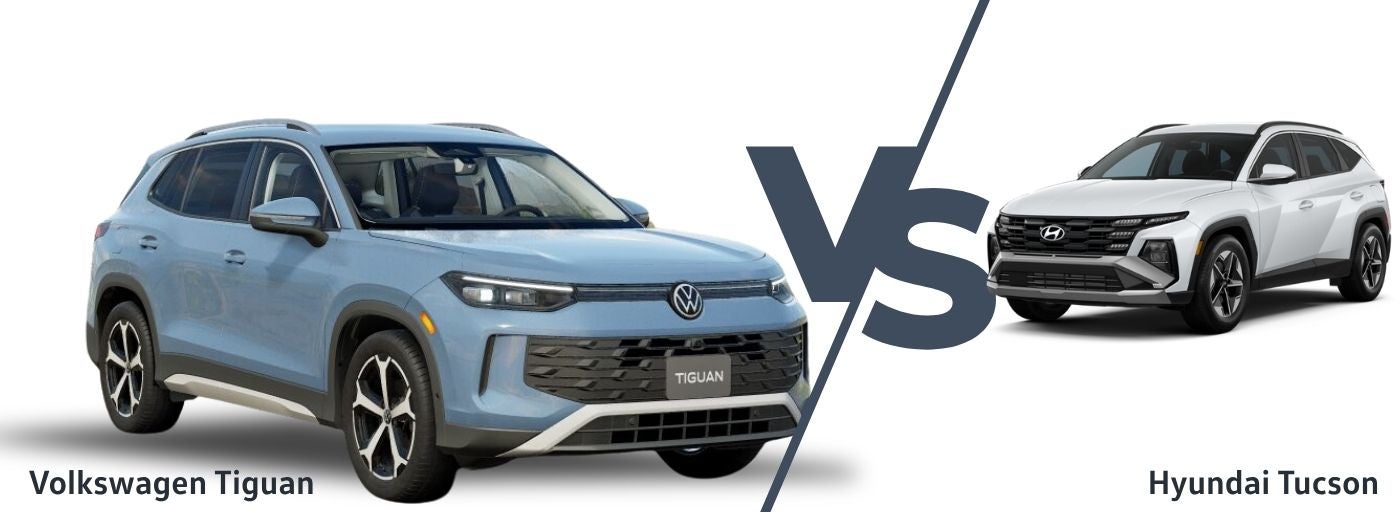
Tiguan vs. Hyundai Tucson
The Hyundai Tucson was introduced in 2004 as a compact alternative to the Santa Fe, which was transitioning from a compact to a mid-size vehicle. It shares all of its mechanical components with the Kia Sportage, though they do not share any styling. The 2026 model year marks the last year of the fourth-generation Tucson, which debuted in 2022. It is built on a smaller version of the platform that supports the Santa Fe. This comparison covers only the non-hybrid model, which is equipped with a naturally aspirated 187-hp 2.5-liter inline-4 engine. Like the Tiguan, the Tucson uses an 8-speed automatic transmission.
- The Tiguan offers more standard horsepower (201 vs.187) and more peak torque (207 or 221 vs. 178 lb-ft).
- The higher peak torque of the Tiguan is attained at a very accessible 1,600 rpm on the Tiguan compared to 4,000 rpm for the Tucson.
- The Tiguan gets better fuel mileage in both FWD (26/34/29 vs. 25/33/28) and AWD (25/32/28 vs. 24/30/26) than the Tucson.
- The 40/20/40 folding rear seat of the Tiguan offers more flexibility than the Tucson's simpler 60/40 split. This design accommodates two passengers in the second row while allowing long, narrow items to extend through the center from the cargo area.
- All Tiguan models feature heated front seats, which is not standard on the Tucson.
- The 12.9-inch screen of the Tiguan is slightly larger than the 12.3-inch screen on all Tucson models, and the Tucson has nothing to compete with the available 15-inch screen.
- The standard heated windshield washer jets of the Tiguan are a feature you will not find on the Tucson.
- It is subjective, but the Tiguan exterior design is likely to age better than the Tucson’s flanks, which have odd body creases, particularly as the Tucson will move on to a new design next year.
- The standard heated washer nozzles of the Tiguan are a useful feature in freezing weather, which the Tucson lacks.
- The Tiguan comes standard with a power tailgate for convenience. This feature requires a trim upgrade in the Tucson.
- Standard Automatic one-touch power for both front and rear windows is a convenience not standard on the Tucson.
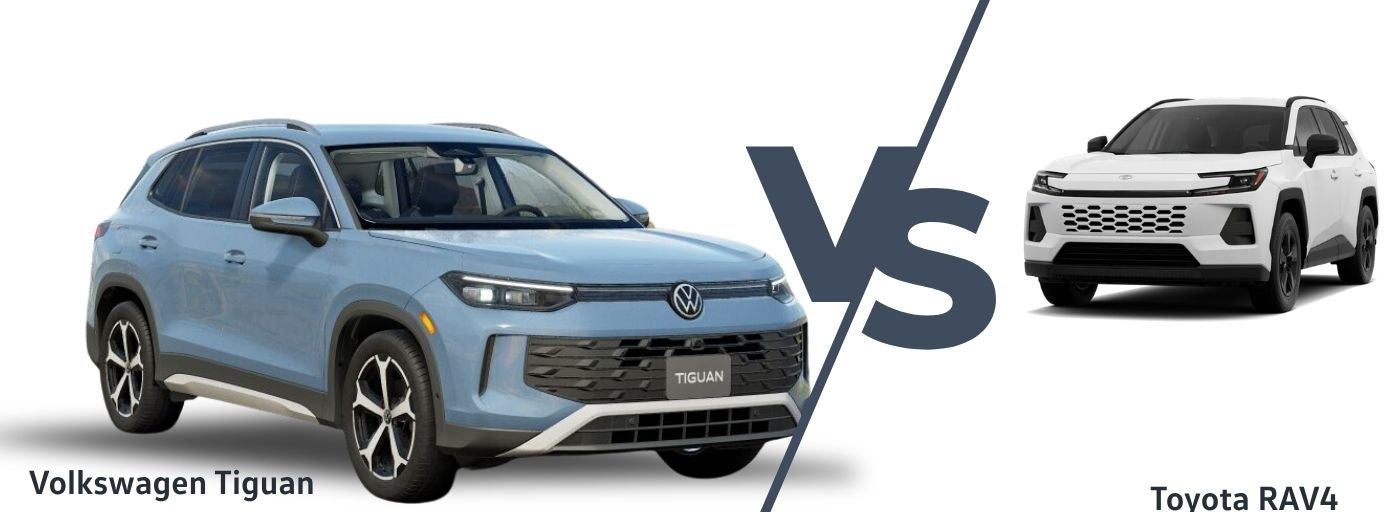
Tiguan vs. Toyota RAV4
Toyota launched the car-based RAV4 in 1994, establishing the compact crossover segment. It is the best-selling model in its category and Toyota’s top-selling model overall. For 2026, the RAV4 launched its sixth-generation model, with the biggest news being that all models now have a hybrid drivetrain. A Plug-in Hybrid is also available. The drivetrain consists of a 2.5-liter engine and an electric motor, for a combined 226 to 236 horsepower. Toyota never publishes torque figures for its hybrid models. Other changes include all-new blockier styling with the hammerhead front styling featured on Toyota’s passenger cars.
- The RAV4‘s horsepower beats the standard horsepower of the Tiguan, but it can’t match the 268 horsepower of the SEL-R model.
- The RAV4’s engine is paired with a continuously variable transmission, while the Tiguan uses a more conventionally behaving 8-speed automatic.
- Neither the standard 10.5” nor the available 12.5” center touchscreens are as large as the standard 12.9” and available 15.0” Tiguan screens.
- The Tiguan has greater passenger volume than the RAV4 (100.4 – 103.8 vs. 98.9 cubic feet).
- The Tiguan has noticeably more rear legroom than the RAV4 (40.2 vs. 37.8 inches).
- Tall drivers or front passengers will have more headroom in the Tiguan (39.7 vs 36.7 inches).
- The Tiguan offers the added flexibility of a 40/20/40 folding rear seat back, unlike the conventional 60/40 split found in the RAV4. This setup allows two passengers to sit in the second row while longer, thinner items extend through the middle of the cargo area.
- Both models have extensive safety and driver-assist technologies. However, the Tiguan can automatically help you steer around an obstacle in your blind spot, whereas the RAV4 only offers warnings.
- The standard heated washer nozzles of the Tiguan are a useful feature in freezing weather that the Tucson lacks.
- The Tiguan comes standard with a wireless phone charger. The RAV4 requires a trim upgrade for that useful feature.
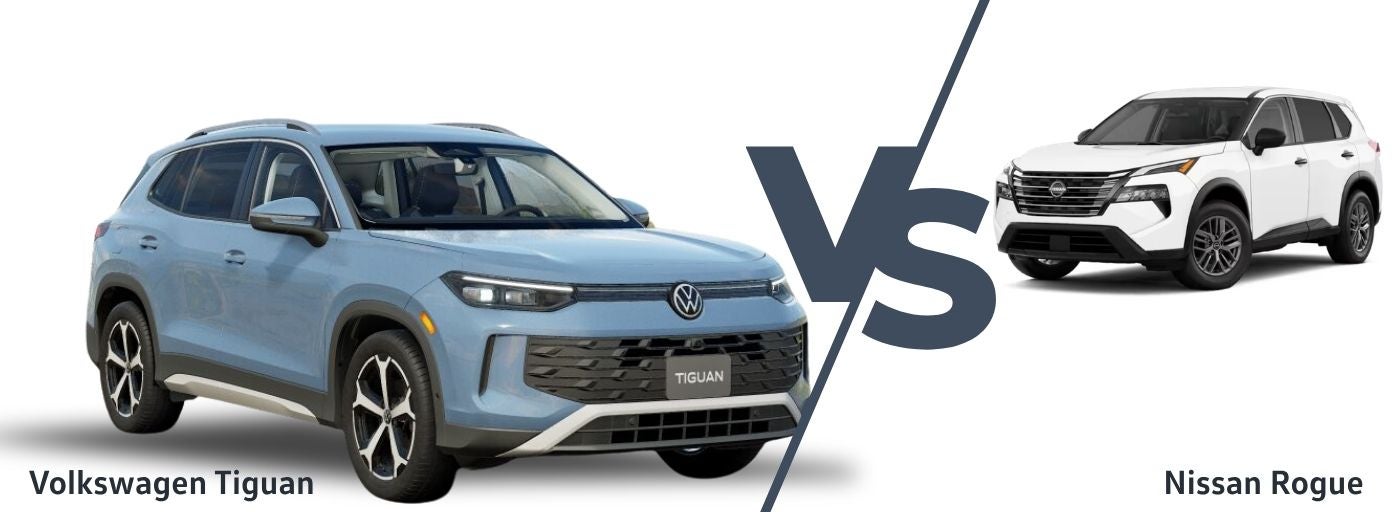
Tiguan vs. Nissan Rogue
The Nissan Rogue, introduced in 2008 and now in its third generation, is Nissan's top-selling vehicle. It is powered by a turbocharged 1.5-liter inline-3 engine. For 2026, a new plug-in hybrid (PHEV) version delivers 248 horsepower and 38 miles of electric-only range. The Rogue is available in trims including S, SV, Rock Creek, Dark Armor, and Platinum. This comparison will focus on the non-hybrid Rogue.
- The Tiguan benefits from an 8-speed automatic transmission, which avoids the drone and rubber-band effect of the Rogue’s continuously variable transmission.
- Between the turbocharger, variable compression system, and the continuously variable transmission, there is a lot of acceleration decision-making between the throttle and the drive wheels that is out of the driver’s hands. By comparison, the Tiguan is much more driver-responsive.
- The Tiguan has a higher maximum towing capacity of 1,800 pounds, compared with 1,500 for the Rogue.
- The standard 12.9-inch Tiguan center touchscreen is larger than both the Rogue’s 8-inch lower-trim screen and its 12.3-inch upgrade on higher trim levels. Higher Tiguan trim levels include a 15.0-inch screen.
- Rear passengers have more legroom in the Tiguan than in the Rogue (40.2 vs. 38.5 inches).
- While the Rogue has only one engine, which matches the Tiguan base engine’s 201 horsepower but with more torque, it has no match for the SEL-R’s more powerful 268-horsepower engine producing 258 lb-ft of torque.
- The Tiguan’s European-tuned chassis balances nimble response with long-term comfort. By contrast, the Rogue has softer, less engaging handling.
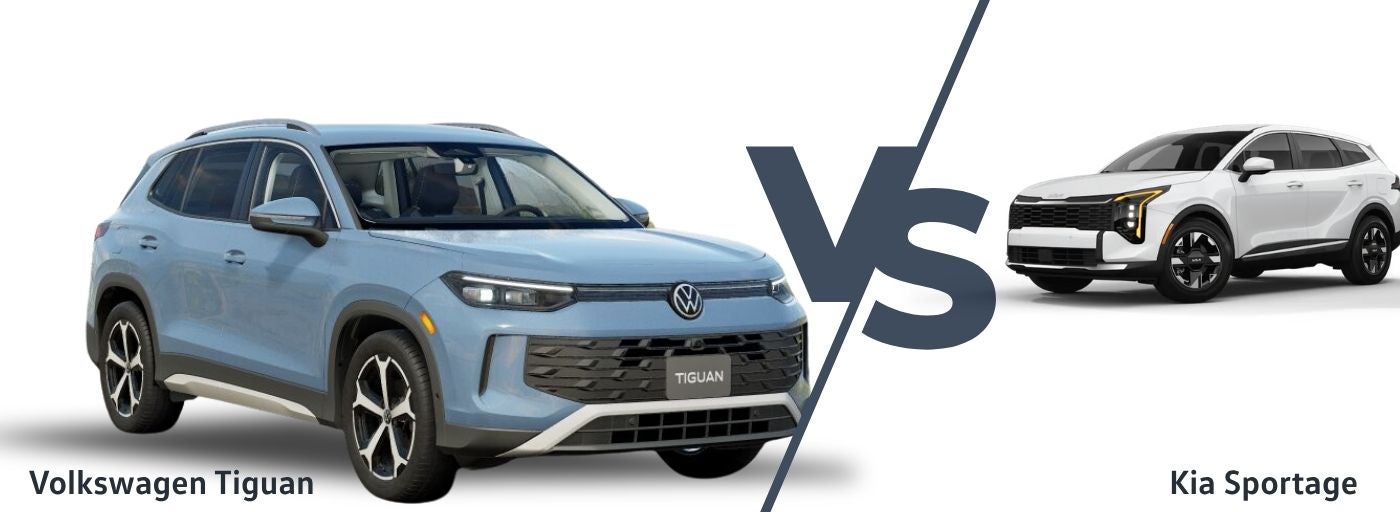
Tiguan vs. Kia Sportage
Introduced in 1995, a few months after the RAV4, the Sportage is among the earliest compact SUVs. Initially, it was a body-on-frame SUV with RWD or 4WD options and a two-speed transfer case, including a 2-door variant. In its second generation, the Sportage shifted to a 4-door crossover, a design it has maintained since. The current fifth-generation Sportage debuted in 2023.
Sharing its platform with the Hyundai Tucson, the Sportage is one of the larger models in the segment. It also offers both non-hybrid and hybrid models, though this comparison focuses on the non-hybrid. The non-hybrid drivetrain features a naturally aspirated 2.5-liter inline-4 producing 187 horsepower and 178 lb-ft of torque. Trim levels include LX, EX, X-Line, SX, SX Prestige, and X-Pro Prestige.
- The standard Tiguan engine is simply more powerful, with more horsepower (201 vs. 187) and more torque (207 vs. 178 lb-ft). The Tiguan AWD model can reach 221 lb-ft of torque.
- The FWD Tiguan delivers slightly better city / highway / combined fuel economy than the FWD Sportage (26 / 34 / 29 vs. 25 / 33 / 28).
- The standard 12.9-inch Tiguan center touchscreen is a little larger than the 12.3-inch screen on the Sportage. It has no match for the Tiguan’s available 15.0-inch screen.
- The 10.25-inch configurable driver information on the Tiguan is standard across the model line. A digital driver display on the Sportage requires a trim upgrade.
- The available Sportage digital driver display lacks the ability to put a navigation map directly in front of the driver as can the Tiguan’s Digital Cockpit Pro.
- Tiguan standard features such as wireless smartphone compatibility, second-row climate vents, and heated front seats require a trim upgrade on the Sportage.
- Luxury features on Tiguan’s top model, such as 10-point massaging front seats, heated outboard rear seats, and three-zone climate control, are not available on the Sportage.
- The Sportage’s airbag system lacks the driver’s knee and front-center airbags that are standard on the Tiguan.
Compare 2026 Volkswagen Tiguan to the Competition
 This page is best experienced in Landscape Mode.
| Standard Crossover | Volkswagen Tiguan | Honda CR-V | Hyundai Tucson | Toyota RAV4 | Nissan Rogue | Kia Sportage |
|---|---|---|---|---|---|---|
| Trims | 3 | 8 | 10 | 10 | 5 | 6 |
| Colors | 9 | 8 | 9 | 6 | 12 | 11 |
| Engine | 2.0-liter Turbo | 1.5-liter Turbo, 2.0-liter Hybrid | Gas - 2.5-liter, Hybrid - 1.6-liter Turbo | Hybrid - 2.5-liter | 1.5-liter Turbo | Gas - 2.5-liter Hybrid - 1.6-liter Turbo |
| Horsepower | 201, SEL-R: 268 | Gas - 190, Hybrid - 204 | Gas - 187, Hybrid - 231, Plug-in - 268 | FWD: 226, AWD: 236, PHEV: 324 | 201 | 187, Hybrid: 232 |
| Torque | FWD - 207 AWD - 221 SEL-R: 258 | Gas - 179 Hybrid - 247 | Gas - 178 Hybrid - 271 Plug-in - 271 | 225 | 178 Hybrid : 271 | |
| Transmission | 8-spd auto | CVT | Gas - 8-spd auto HEV/PHEV - 6-spd auto | CVT | CVT | 8-speed auto Hybrid: 6-speed Auto |
| DriveTrain | Standard - FWD Optional - AWD | Standard - FWD Optional - AWD | Standard - FWD Optional - AWD | Standard - FWD Optional - AWD | Standard - FWD Optional - AWD | Standard - FWD Optional - AWD |
| Fuel Economy (City/Hwy/Comb) | FWD: 26 / 34 / 29 25 / 32 / 28 AWD: 22 / 32 / 25 22 / 29 / 25 | FWD: 28 / 33 / 30 AWD: 27 / 31 / 29 Hybrid: FWD: 43 / 36 / 40 AWD: 40 / 34 / 37 | FWD: 25 / 33 / 28 AWD: 24 / 30 / 26 Hybrid: Blue: 38 / 38 / 38 FWD: 36 / 37 / 36 | FWD: 47 / 40 / 43 AWD: 46 / 39 / 42 | FWD: 29 / 36 / 32 AWD: 28 / 35 / 31 | FWD: 25 / 33 / 28 AWD: 24 / 30 / 26 Hybrid: FWD: 41 /44 / 42 Hybrid: AWD: 35 / 36 / 35 |
| Fuel Tank Capacity (Gallons) | 14.5 | 14 | 14.3 | 14.5 | 14.5 | 14.3 |
| Infotainment | Standard - 12.9" Optional - 15" | Standard - 9" Optional - 10.2" | Standard - 12.3" | Standard - 10.5" Optional - 12.5" | Standard - 8" Optional - 12.3" | Standard - 12.3" |
| Passenger Volume | 103.8 cu.ft. | 106 cu.ft. | 108.2 cu.ft. | 98.9 cu.ft. | 105.4 cu.ft. | N/A |
| Front Headroom | 39.5 | 40 | 40.1 | 36.7 | 41.1 | W/O Sunroof - 39.6 W/ Sunroof - 37.8 |
| Front Legroom | 40.2 | 41.3 | 41.4 | 41.0 | 41.5 | 41.4 |
| Rear Headroom | 39.7 | 38.2 | 39.5 | 36.7 | 39.2 | W/O Sunroof - 39.1 W/ Sunroof - 37.8 |
| Rear Legroom | 40.2 | 41 | 41.3 | 37.8 | 38.5 | 41.3 |
| Cargo Space Behind Rear Seats | 33.8 cu.ft. | 39.3 cu.ft. | 38.7 cu.ft. | 36.6- 37.8 cu.ft. | 36.5 cu.ft. | 39.5 cu.ft. |
| Cargo Space Rear Seats Folded | 69.8 cu.ft. | 76.5 cu.ft. | 74.8 cu.ft. | 69.8 to 70.4 cu.ft. | 74.1 cu.ft. | 73.7 cu.ft. |
| Base Price | $30,805 | $30,920 | $29,450 | $31,900 | $29,490 | $28,790 |
Why Buy from Sisbarro Volkswagen?
At Sisbarro Volkswagen, you will have an automotive experience unlike any other. You can find new Volkswagen inventory, including the Taos, Atlas, GTI, Jetta, ID.Buzz, ID.4, and an unmatched collection of used car, truck, van, SUV, and crossover inventory at our dealership in Las Cruces, NM. Are you interested in leasing or financing your Volkswagen Tiguan? The Finance Department at Sisbarro VW can help you find the right lease offer or finance solution that fits your budget. We cultivate relationships with many banks, lenders, and other financial organizations to provide you with great options in purchasing your new vehicle. In addition to the comprehensive factory warranty that comes with your new Tiguan, we offer extended warranty and protection programs to safeguard your investment. Get the best deals and specials available to you on the Volkswagen Tiguan. Our knowledgeable sales staff wants to help you find the perfect fit in a new Volkswagen or used car. We can’t wait to welcome you to the Sisbarro Volkswagen family and help you find your new car or used vehicle. Your support and customer service doesn’t stop after you sign your deal. The expert Service Department at our Volkswagen dealership in Las Cruces, NM is always ready to help with any repairs or maintenance you might need to keep your vehicle running perfectly. Our Express Service Lane will get you back on the road quickly when you need basic maintenance like an oil change or tire rotation. Would you like to make your new car all your own with personalized upgrades? Our well-stocked Parts Department has all of the Volkswagen genuine parts and accessories you need for the best customization of your vehicle. Make your car, truck, or SUV uniquely yours to fit perfectly in your lifestyle. We are eager to help you on your car buying and vehicle ownership journey. Visit us today at Sisbarro Volkswagen!

We’re sorry, availability of some equipment, options or features may be limited due to global supply issues affecting the auto industry. Please be sure to verify that the vehicle you purchase includes all expected features and equipment.