
Blog / Golf GTI

Volkswagen Golf GTI vs. Golf R for New Mexico Driving

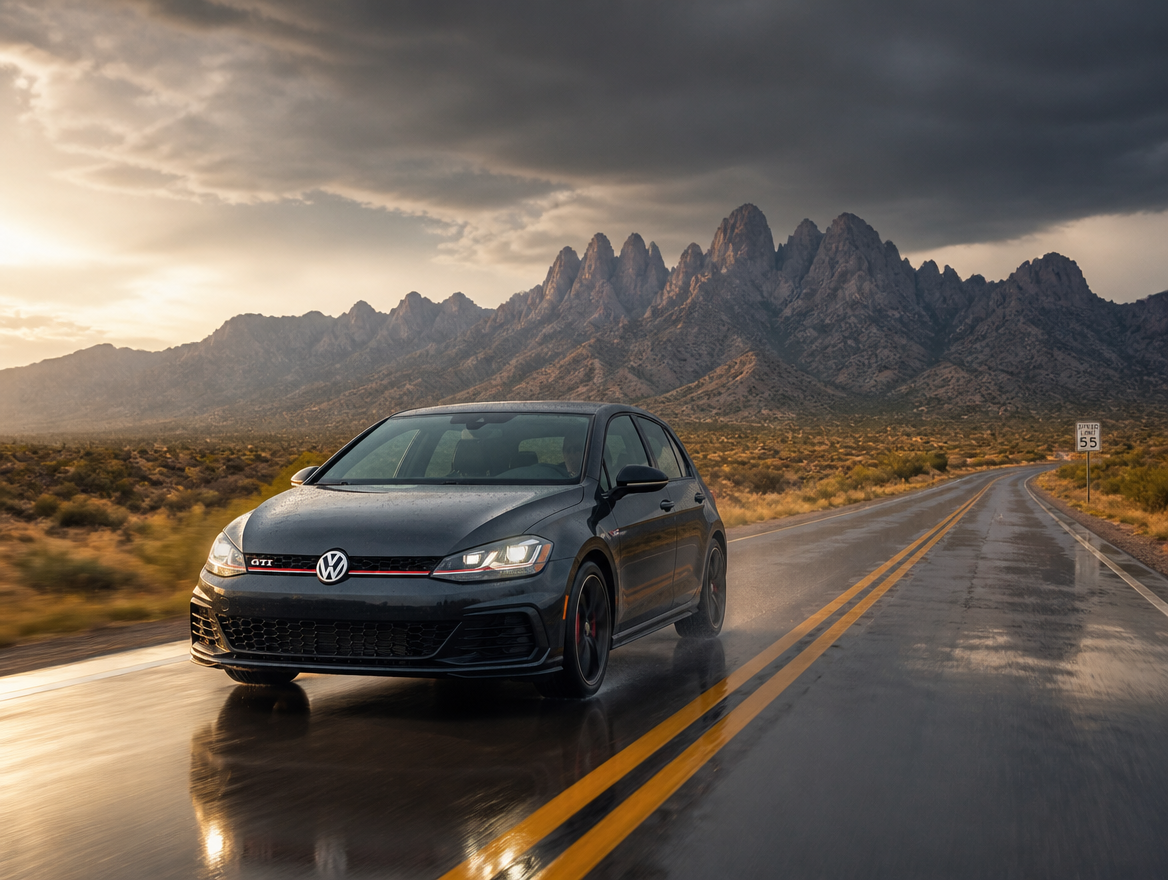
2026 Volkswagen Golf GTI on a rain-slicked New Mexico desert highway with Organ Mountains in the background under monsoon clouds

November in Las Cruces marks the tail end of monsoon season. Weeks of sun bake an oil-and-dust film into the asphalt on I-10, US-70, and every frontage road in the Mesilla Valley. An afternoon storm drops half an inch of rain in twenty minutes, that film floats, and a car that felt planted at 65 mph suddenly asks you a question you weren't expecting. That's when the front-wheel drive of the Golf GTI and the standard 4MOTION all-wheel drive of the Golf R stop being a spec-sheet debate. They become a real local question.

For most Las Cruces routines, the Golf GTI handles southern New Mexico roads with full confidence. The Golf R earns its AWD premium when the desert decides to remind you it's still a desert.

Golf GTI vs. Golf R on Desert Pavement: What Each Car Actually Does

The 2026 Golf GTI and the 2026 Golf R share the same 2.0-liter turbocharged four-cylinder engine family, so on paper they read like siblings, but how each one puts power down is where they split, and on New Mexico roads that difference is the whole decision.

Condition Golf GTI (FWD + VAQ LSD) Golf R (4MOTION AWD + torque vectoring) Practical edge
Dry I-10 or I-25 at highway speed 241 hp, 273 lb-ft, 7-speed DSG. VAQ limited-slip differential balances front torque delivery 328 hp, 295 lb-ft, same transmission family. AWD keeps all four tires working Golf R on raw thrust; Golf GTI feels precise and lighter
First rain on oil-glazed summer desert asphalt VAQ LSD reduces wheelspin at the front. Firm braking and straight-line entry matter 4MOTION shifts torque across all four wheels; rear torque vectoring can direct up to 100% of rear-axle torque to one rear wheel Golf R holds a clear margin here
Standing water on flat desert highway ESC intervenes well. Golf GTI is about 200 lbs lighter, which aids quick directional changes AWD adds front-to-rear distribution on top of the same ESC suite Golf R, though the gap is smaller than its horsepower difference implies
Dry canyon road heading toward the Organ Mountains Precise and communicative. Less weight through the turns More grip, more power, but heavier Driver preference; many find the Golf GTI more engaging
NMSU campus, El Paso corridor daily commute EPA-estimated 24 city / 32 highway mpg EPA-estimated 22 city / 31 highway mpg Golf GTI wins on efficiency
Las Cruces altitude (roughly 3,900 ft) and thin air Both are turbocharged. Turbo compensates for lower air density at our elevation Same turbo engine family, same compensation Essentially equal

EPA figures are estimates. Actual fuel economy varies with driving conditions and habits.

The Technique That Matters Most on Monsoon-Season Roads

The technique that matters most on monsoon roads is nothing fancy, and it works even in the AWD Golf R, so just slow down the instant rain touches dry pavement, since the first minutes are the most treacherous stretch of any desert storm and no driveline erases that.

The New Mexico Department of Transportation notes that storms here can intensify quickly, and because desert ground doesn't absorb water fast, pavement saturation happens with very little warning. The first ten minutes of any desert rainstorm are the worst. That oil-and-dust film that's been building since June goes slick before the rain rinses it away. The pavement turns on you fast.

Here's the numbered sequence our team recommends for both cars on monsoon-season roads.

  1. Check conditions before leaving. NMDOT's nmroads.com and the 511 system update road closures and conditions in near-real time during active storm cells.
  2. Slow down the moment rain starts on dry pavement. Not after it's been raining for ten minutes. The first drops on a dry desert road are the most dangerous surface you'll encounter.
  3. Brake on the straight, not in the curve. Both the Golf GTI and Golf R give you a firm, communicative brake pedal. A straight-line brake preserves all four tires for cornering grip, and doing both at once asks too much of the contact patch.
  4. Watch every low-water crossing and arroyo crossing on US-70 east. Flash-flood runoff crosses the road faster than storm radar moves, and neither AWD nor FWD changes what happens once water is already moving across pavement.
  5. Use Comfort or Normal drive mode in standing water. Sport mode sharpens throttle response in a way that can upset traction when grip is marginal. Save Sport mode for the dry roads it's designed for.

In the Golf GTI, the VAQ limited-slip differential is doing real work on these roads (not just padding the spec sheet). It redirects torque away from the front wheel that's beginning to slip, which is exactly the scenario rain-glazed desert asphalt throws at you. In the Golf R, the 4MOTION system's rear torque vectoring goes further. The technical documentation of Volkswagen confirms it can push up to 100% of rear-axle torque to a single rear wheel, which gives you a wider margin before a correction becomes necessary.

There's a limit worth naming, though. AWD extends the threshold. It doesn't remove it. Both cars put rubber on the same pavement, and both reward the same fundamentals, reduced entry speed, early braking, and not asking the tires to do two jobs at once. AWD buys margin, nothing more.

See our current new inventory to compare what's on the lot right now. If you want to talk through which car fits your actual drive, our financing team can walk through the numbers alongside the spec sheet.

Altitude note from our team: Las Cruces sits at about 3,900 feet. Both cars are turbocharged, and the turbocharger compensates meaningfully for the thinner air at our elevation. A naturally-aspirated engine loses roughly 3% of its rated power for every 1,000 feet above sea level. A turbocharged engine like the EA888 in both of these cars recovers most of that loss by forcing air into the intake regardless. The altitude isn't why you'd choose one over the other here.

Explore Financing Options

The Recap: Right Car for the Right Southern New Mexico Driver

If your routine is Las Cruces to El Paso on I-10, NMSU commutes, and the occasional weekend push north on I-25, the Golf GTI handles the high desert well all year, and it's the one that suits most of the driving here, with the Golf R held in reserve for the days the desert turns on you. It's more efficient, around 200 lbs lighter, and earns its keep on the dry roads that define most of our driving calendar. The standard 4MOTION AWD of the Golf R is genuinely valuable on the monsoon days when desert pavement goes from bone dry to glazed in five minutes, and for anyone who regularly runs north into higher elevations where conditions change faster. Both cars. Same platform. One fits the desert 340 days a year. The other fits all 365, with more power to spare. Schedule a pre-trip service check before your next long haul, or stop in and we'll put you in the right seat.
Sisbarro Volkswagen

1115 S Valley Dr, Las Cruces, NM 88005

(575) 319-9131

Posted in:

Related Posts

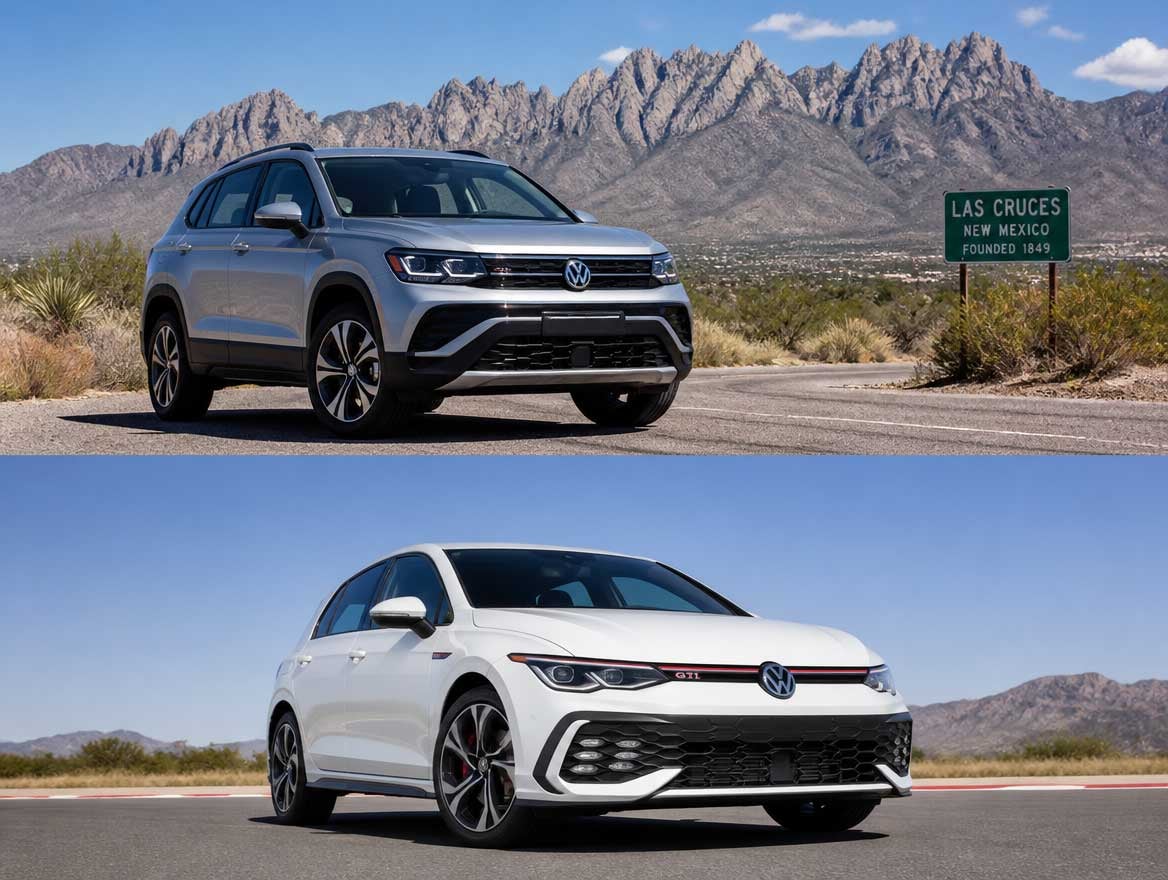
2026 Volkswagen Taos SUV and 2026 Volkswagen Golf GTI side by side on a Las Cruces desert road

Volkswagen Taos vs. Golf GTI: Practical SUV or Hot Hatch for Las Cruces?

For most Las Cruces drivers, the 2026 Volkswagen Taos is the right call. It seats five, carries up to 27.9 cubic feet of cargo behind the rear seats, runs 31 combined mpg on the EPA cycle, and offers available 4MOTION AWD for monsoon-season roads and the occasional dirt detour. The 2026 Golf GTI is the right call if driving feel is your actual purchase reason, not a bonus. Browse the 2026 Volkswagen Taos at Sisbarro Volkswagen How Do These Two Cars Actually Compare on the Things That Matter Day-to-Day? Both cars share the same German DNA and the same turbocharged philosophy, but that's where the overlap ends. The Taos is built to carry your life, and the Golf GTI is built to make you feel something every time you pull out of a parking lot. The side-by-side below answers it directly. Decision axis 2026 Volkswagen Taos (FWD) 2026 Volkswagen Golf GTI Engine 1.5L turbo TSI, 174 hp, 184 lb-ft 2.0L turbo TSI EA888, 241 hp, 273 lb-ft 0 to 60 mph 8.2 seconds 6.0 seconds (Volkswagen official) EPA fuel economy 28 city / 36 hwy / 31 combined mpg 24 city / 32 hwy / 27 combined mpg Cargo (seats up) 27.9 cu ft (FWD); 24.9 cu ft (4MOTION) 19.9 cu ft Cargo (seats folded) 65.9 cu ft (FWD) 34.5 cu ft Rear seat legroom 37.9 inches Fits four adults, bolstered sport seats Drivetrain options FWD or 4MOTION AWD Front-wheel drive only Transmission 8-speed automatic (FWD) or 8-speed DSG (4MOTION) 7-speed DSG or 6-speed manual Ground clearance 6.6 inches Lower sport car stance Best fit Families, commuters, errand-runners Driving enthusiasts, solo or co-pilot The numbers tell the obvious story. Volkswagen rates the Taos at 31 combined mpg with front-wheel drive, four full mpg better than the Golf GTI EPA-rated 27 combined. Over 45 miles of I-10 between Las Cruces and El Paso, that gap adds up in a way you'll notice at the pump across a year. And with both rear seats in place, the cargo space of the Taos runs nearly double the cargo space of the Golf GTI. See 2026 Golf GTI inventory at Sisbarro Volkswagen Look at the engine column, though, and the dynamic shifts. The 2.0L EA888 of the Golf GTI makes 241 horsepower and 273 pound-feet of torque, routed through a 7-speed DSG dual-clutch. The Taos does 174 hp and 184 pound-feet. That's not a small gap. Merge onto I-25 from the university side during rush hour and you'll feel it. Need more space and more power? The Tiguan might be the middle ground. For most Mesilla Valley commuters and families, the Taos handles real life better. For the driver who genuinely cares about how the car feels to drive, the Golf GTI is the one worth stretching for. Team perspective: The idea of the Golf GTI is easy to love, but a lot of everyday routines are really a Taos life. One car in the garage, dog in the back, Costco run on Saturday, White Sands day trip on Sunday. The cargo area of the Golf GTI (19.9 cubic feet behind the rear seats) is a real constraint for that routine. That 8.0-cubic-foot difference versus the Taos is roughly one large dog crate. What Does Each Car Give Up, and Will You Actually Miss It? Each car gives up something real, and whether you'll miss it comes down to how you drive. Neither one is a compromise in isolation. Each is a clear winner for a specific buyer and a clear mismatch for another, so the trade only stings if you buy the wrong one for your routine. What the Taos gives up. Driving feel, full stop. The 1.5-liter turbo is smooth and perfectly adequate, but it isn't engaging. Volkswagen tuned it for efficiency and composure, not for the grin you get from 273 pound-feet hitting the front wheels through a DSG. Buy a Taos expecting a Golf GTI that holds more stuff and you'll be mildly disappointed every time you want to pass on a two-lane stretch of US-70 east toward White Sands. It takes 8.2 seconds to reach 60 mph. The Golf GTI gets there in 6.0 flat by the published figures of Volkswagen. What the Golf GTI gives up. Cargo, AWD, and seating versatility. The 19.9 cubic feet behind the rear seats is a real number with real consequences. You can fit two carry-on bags and a backpack, but you can't comfortably fit three adults' luggage for a road trip and a cooler. There's no AWD option, either. None. The Golf GTI is front-wheel drive only, across all three trims. For most of the Chihuahuan Desert calendar that's fine. During monsoon season, when an afternoon storm turns an arroyo crossing to a muddy slick in fifteen minutes, the Taos with 4MOTION AWD and four adjustable drive modes (including an off-road setting) is a meaningfully different machine. Explore Financing Options at Sisbarro Volkswagen Which One Makes More Sense for the Las Cruces Lifestyle? Which one fits Las Cruces depends on your terrain and your calendar, and the town hands you both to weigh. It sits at roughly 3,900 feet in the Chihuahuan Desert, at the junction of I-10 and I-25, which shapes what a car actually needs to do here. Around 320 sunny days a year means neither car gets punished by weather most of the time. But the summer monsoon pattern from July through September delivers brief, intense downpours that can leave standing water on low points of surface roads. And if your life involves Organ Mountains-Desert Peaks National Monument day hikes, the access roads are unpaved. For that driver, the Taos with 4MOTION AWD is the practical answer. Its 4MOTION system includes four selectable drive modes with a dedicated off-road setting, which is unusual for a subcompact SUV. Ground clearance sits at 6.6 inches. It handles gravel and compressed caliche without drama, truck or not. For the NMSU student or the commuter doing solo I-10 miles in a compact car, the smaller footprint of the Golf GTI is genuinely useful. It parks easily, and it's quick in stop-and-go traffic because the DSG shifts are near-instantaneous at low speed. It also carries 27 combined mpg on the EPA cycle for a 241-horsepower engine, which is a fair trade. The hatchback body also gives you 34.5 cubic feet with the rear seats folded, enough for a weekend bag or a flat-pack furniture run. That's not nothing. Browse all available new Volkswagen vehicles at Sisbarro Volkswagen The real tiebreaker for Las Cruces: how many people and how much stuff are in the car most of the time? One person, a laptop bag, and a commute? Golf GTI. A family of four plus the expectation of being the trip car, the errand car, and the weekend car? Taos. Frequently Asked Questions Is the Golf GTI practical enough to use as a daily driver in Las Cruces? Yes, with realistic expectations. The 2026 Golf GTI carries 19.9 cubic feet of cargo behind the rear seats and seats four adults with genuine comfort. For a solo commuter or a two-person household without regular cargo demands, it works well as a daily driver. The EPA rates it at 27 combined mpg. Where it falls short is cargo depth for a family routine and the absence of any AWD option, which matters when monsoon-season road conditions hit the Mesilla Valley. Does the Volkswagen Taos come with all-wheel drive? Yes. The 2026 Taos is available with 4MOTION AWD on all trim levels except the base S, which comes in FWD only. The 4MOTION system includes four selectable drive modes, one of them a dedicated off-road setting. Move up to 4MOTION and the transmission also upgrades to an 8-speed DSG dual-clutch automatic for quicker response. Cargo volume behind the rear seats drops slightly with 4MOTION (24.9 cu ft versus 27.9 cu ft with FWD) because of the AWD hardware under the floor. Which gets better fuel economy, the Taos or the Golf GTI? The Taos. The 2026 Taos earns an EPA estimate of 31 combined mpg with front-wheel drive, compared to 27 combined mpg for the Golf GTI. On the highway the gap narrows to 36 mpg for the Taos (FWD) versus 32 mpg for the Golf GTI. If you add 4MOTION AWD to the Taos, fuel economy comes down to 28 combined mpg, which is still slightly ahead of the GTI. The Taos also accepts regular 87-octane fuel; confirm the fuel requirement of the Golf GTI with our team, as performance engines sometimes specify premium. Get a Trade-In Estimate Before You Decide Sisbarro Volkswagen 1115 S Valley Dr, Las Cruces, NM 88005 (575) 319-9131

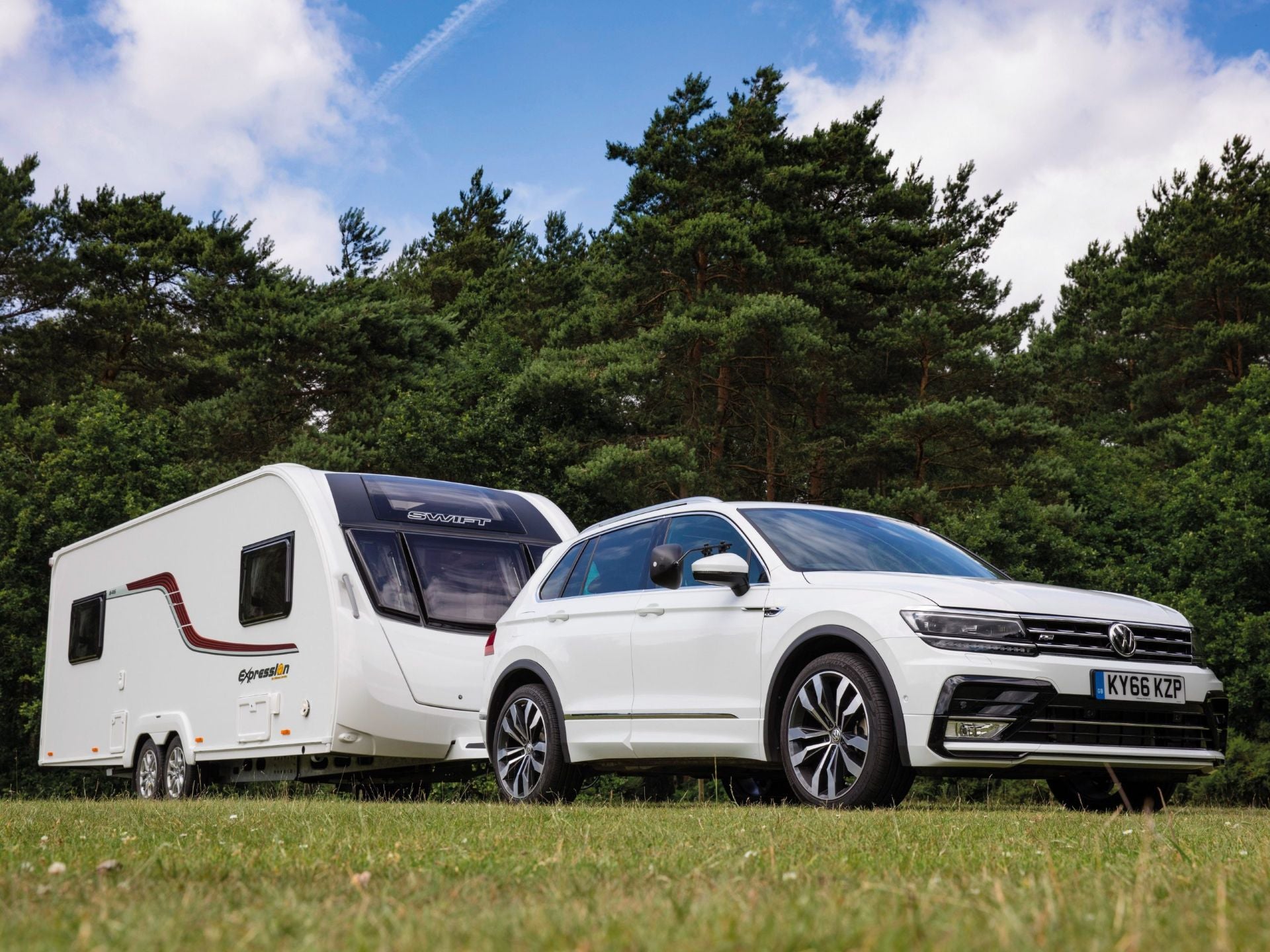
The Powerful Volkswagen Tiguan Towing A Long, White Trailer With Ease

How Much Can a Volkswagen Tow?

Sometimes, the trunk or cargo hold isn’t enough, and attaching a roof rack isn’t sufficient either because what you want to take is too large to pack in or on your vehicle. Sometimes, what you want to take is even a temporary home or a motorized toy for trail, snow, or water. Big trailers need a towing-focused vehicle, but what if you're towing something light? Can you do it with a regular Volkswagen? Possibly. Sisbarro Volkswagen discusses what you can and cannot tow with your Volkswagen. Cars used to be built differently, mostly with body-on-frame construction, where the chassis handled all loads, and the body was simply bolted on. This allowed a single model line to offer a range of body styles, including sedans, coupes, convertibles, and station wagons. Volkswagen, for example, built multiple models, including the Beetle, Bus, Fastback, Kammback, and Karman Ghia, on mostly the same chassis. Towing ability was common among these vehicles because load impacts were absorbed by the chassis alone. Rear-wheel drive also helped by limiting trailer loads to the frame between the rear axle and the hitch. Even the Beetle could tow up to 1,500 pounds, though steep inclines challenged its engine. Today, most cars and crossovers are built using unibody construction, in which the body itself serves as the frame.  There are several advantages of this, including weight reduction, which improves both performance and efficiency, and better handling because the body has less flex, enabling a more comfortable and quieter ride. Front wheel drive architecture in which the engine is turned sideways with the transmission beside it (instead of behind) and the crankshaft essentially lines up with the front axles.  Almost every all-wheel-drive vehicle uses a front-wheel-drive architecture, including all modern Volkswagen models. One drawback of unibody construction is that it limits towing ability. This is because the towing pull stress is now distributed across the entire vehicle body, and the front-wheel-drive architecture exacerbates the problem. This doesn’t mean that no unibody vehicles can tow, but most will tow less than similar-sized body-on-frame vehicles, which are now mostly pickup trucks and SUVs on pickup-truck chassis. This may lead you to wonder if any VW vehicles can tow at all.  The answer is some can, and some cannot. Cannot Tow In general, towing increases with the vehicle size. Thus, it is the smaller models that are not recommended for towing of any kind.  These include: Golf GTI and Golf R Jetta and Jetta GLI Taos Can Tow The Tiguan, when fitted with a Class 1 hitch, can tow up to 1,500 pounds with FWD and 1,800 pounds with AWD.  This may be enough for a compact camping trailer with room for one double bed and a small kitchen.  It may also be enough for a trailer containing a single mid-size ATV or two dirt bikes. With a properly installed hitch, the Atlas and Atlas CrossSport are both rated to tow up to 5,000 pounds regardless of whether they are FWD or AWD.  This is enough for most pop-up campers and light travel trailers from 15 to 20 feet that sleep four and have amenities like a bathroom and even a single slide-out to expand the living space.  Some small boats and trailers may also come under this figure. Can Tow But… Electric motors' high torque aids towing; the ID.4 has a max capacity of 2,200–2,700 pounds, depending on the model, and the ID.Buzz can tow 3,500 pounds with AWD and 2,700 with FWD. Range reduction limits practicality for long-distance towing. Towing reduces a vehicle’s efficiency—but it’s more critical for EVs because they have limited stored energy. The larger 82kWh battery of the ID.4 holds about 2.4 gallons of gas, and the electric motor’s efficiency enables up to 291 miles on a full charge, but trailers can reduce this range. Know Your GCWR Knowing the trailer weight isn't enough for safe towing; you must also consider your model’s Gross Combined Weight Rating (GCWR), the maximum total combined weight of your vehicle and trailer, including passengers, cargo, and fuel. Exceeding GCWR can cause brake failure and damage. For example, the Atlas's GCWR is about 9,000–10,000 pounds, depending on the model. If fully loaded with passengers, cargo, and additional trailer cargo, you may go over the limit. It's best to weigh your vehicle and trailer at a public scale and add passenger and cargo weight before towing. If you have something you want to tow with your Volkswagen, ask the experts at the Sisbarro Volkswagen Service Department about the best steps to take.

Volkswagen GTI Concepts

VW Celebrates 50 Years of the GTI With 3 Concepts

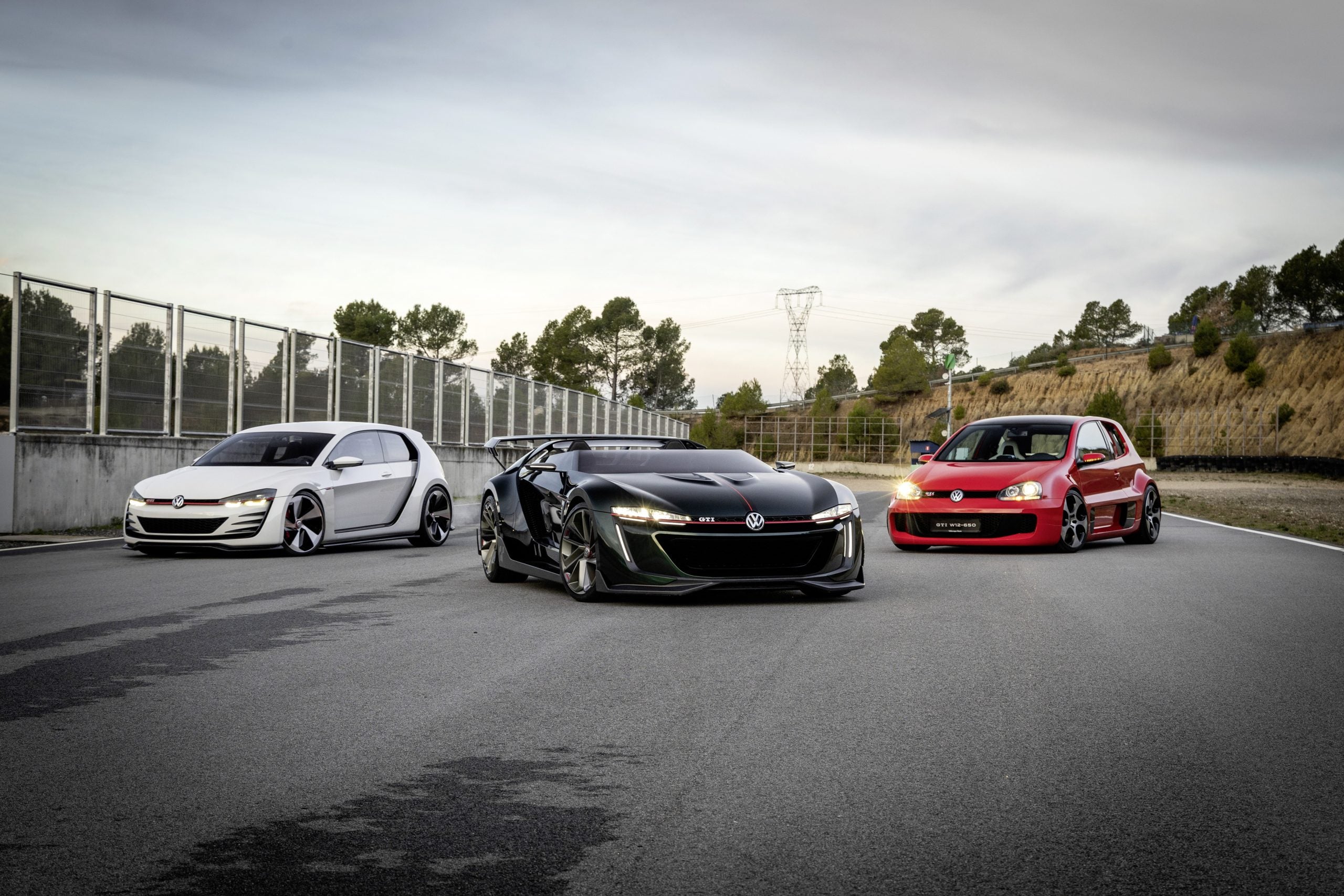
Since 1976, the Volkswagen GTI has been a trendsetter in automotive culture. As the first hot hatch, it’s created multiple generations of competitors that have never been able to quite capture the hearts and minds of car buyers the way the GTI has. 50 Years Young To mark 50 years and 2.5 million cars sold to date, Volkswagen is celebrating its birthday with a series of global events, three unique concepts, and the release of the first-ever electric GTI. A GTI and A 12 Cylinder Engine The concepts are not new to the GTI world, as they debuted in 2007, 2013, and 2014. However, they are a reminder of what the spirit and creativity of the car mean to enthusiasts. The first concept, the GTI W-12, was a car that answered a question no one had. What if Volkswagen stuffed a Bentley 12-cylinder engine behind the front seats of a fifth-generation GTI? What we got was a powerhouse with 650 horsepower and 553 lb-ft of torque from a 6.0-liter W-12, a dual-clutch transmission, and a 0-60 time of 3.5 seconds and a top speed of 202 mph. To accomplish this, VW lowered the car by three inches and widened it by six to work properly, then put a rear axle and brakes from a Lamborghini, the engine from a twin-turbo Bentley Continental, a carbon fiber roof, and rear suspension and such from an Audi R8. Before Becoming a Farmer, Jeremy Clarkson Reviewed Cars In the debut episode of series 10, Top Gear’s Jeremy Clarkson enjoyed a hot drive in the GTI W-12. He said it wasn't a particularly savage car in terms of performance, but it just wouldn’t stop going once you pushed the accelerator. While the car was originally painted Candy White, it has since been repainted Tornado Red. A Seemingly Simple Yet Special Concept The next car VW showed off was the Design Vision GTI concept at the 2013 LA Auto Show. This special model featured a twin-turbocharged 3.0-liter V6 that produced 503 horsepower and 413 lb-ft of torque, according to Volkswagen. Engineers widened a Mk7 GTI by 2.8 inches, lowered it to squat over the wheels, installed one-off 20-inch wheels with center locks, fitted carbon-ceramic brakes, and added special bodywork with new side air intakes and vents. The interior was inspired by the Audi R8 at the time and stripped for weight savings, with Alcantara and carbon-like appointments throughout the cabin, plus red door pulls instead of handles. Volkswagen ripped the rear seats out and put a massive X-brace in their place to stiffen the chassis. Fantastically Fast With a dual-clutch DSG transmission and 4Motion all-wheel drive, VW said this unique GTI could reach 60 mph in just 3.9 seconds and top out at 186 mph. This was quite a bit quicker off the line than the Mk7 GTI at the time, which, according to Car and Driver, required 5.6 seconds to 60, a brisk time even by today’s standards. The Most Unique GTI Ever Volkswagen followed the success of the previous two cars by introducing a very special one-off: a roadster built for Gran Turismo 6. The GTI Roadster offered the same twin-turbo V6 as the Design Vision GTI. The GTI Roadster, though, turns the GTI into a Speedster, with short windows and a windshield, plus scissor doors, a giant rear wing, and all-new bodywork and one-off wheels. With meatier tires and larger brakes, the 2014 GTI Roadster was quite possibly the most special of all the concepts. Volkswagen Means Value While the GTI is synonymous with performance and value, all Volkswagen vehicles are engineered and priced to offer more than you would expect for their reasonable prices. The 2026 models are some of the best values Volkswagen has ever offered, and Sisbarro Volkswagen has the best sales team to help you find the exact vehicle you want at the price you need. Why Choose Sisbarro Volkswagen It's time for you to treat yourself to a visit to Sisbarro Volkswagen. At Sisbarro Volkswagen, we are proud to offer the best prices and services on both new and used Volkswagen models. Our sales team will work to find you the car you want, and our finance department will help you get the best possible price. When it’s time to service your car, our service department will work hard to ensure your car or SUV receives the best care imaginable. We thank you for trusting us, and we look forward to serving you soon.