
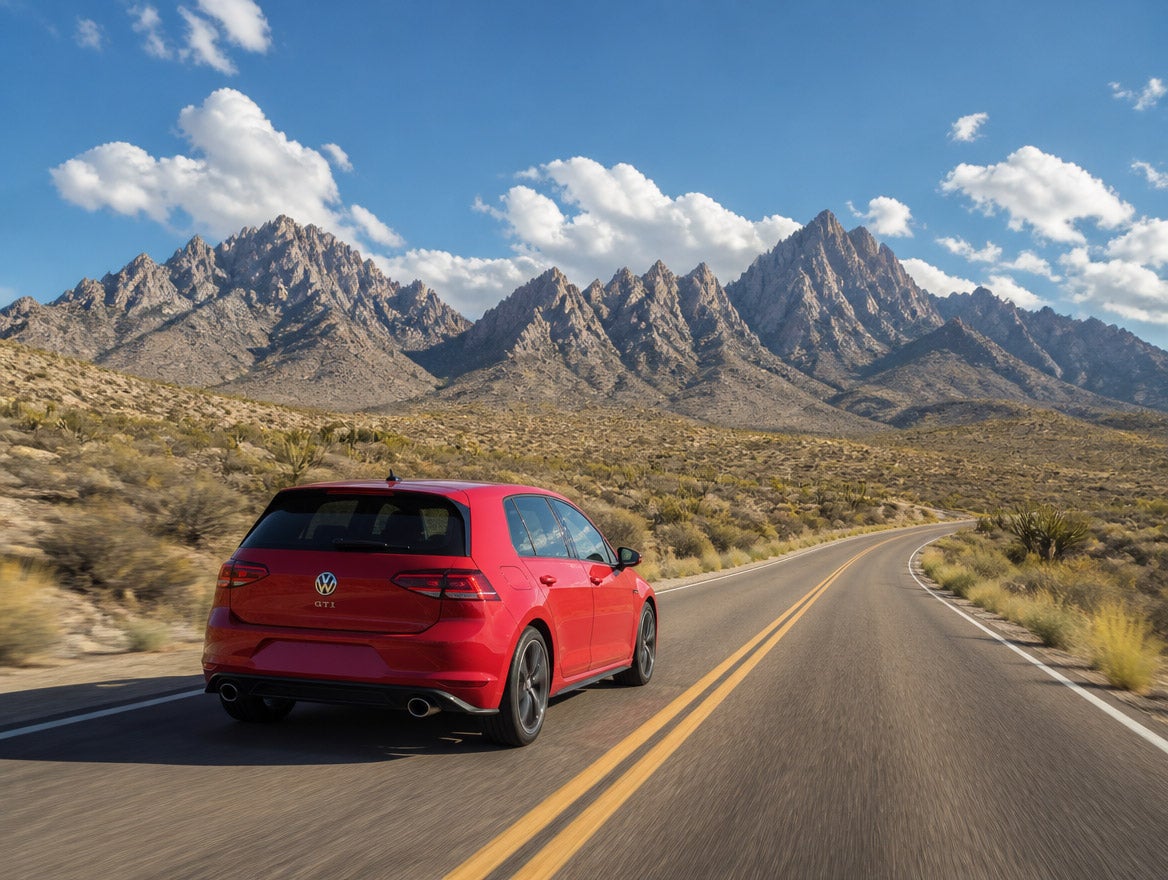
Drivers heading east on US 70 between Las Cruces and Alamogordo are usually bound for White Sands National Park, commuting to Holloman AFB, or making a run up to the Sacramento Mountains. We know this route well from our lot. If you've wondered whether a compact hot hatch is the right tool for it, the straight answer is that it's a strong match for this specific corridor, with one real tradeoff you should understand before you go.
The 2026 Volkswagen Golf GTI puts 241 horsepower and 273 lb-ft of torque through a seven-speed dual-clutch gearbox, and that powertrain is built around efficiency on sustained highway runs. The EPA rates the 2026 Golf GTI at 32 miles per gallon on the highway. Once you clear the Organ Mountains and drop into the Tularosa Basin, the gas stations thin out. Out here, range counts.
Why Does the Golf GTI Fit This Route?
The Golf GTI fits this route because a low, torque-rich hatch handles the pass climb, the open-desert crosswind, and the stop-and-go reality of missile-range closures better than its size suggests, though it asks you to accept a firmer ride in exchange. Every US 70 run east of Las Cruces poses the same question about how your vehicle handles those three things.
| Local Condition | Golf GTI Feature | Why It Matters Here |
|---|---|---|
| San Augustin Pass climb (5,710 ft elevation) | 241 hp / 273 lb-ft turbocharged torque, 7-speed DSG | Strong low-end pull; the dual-clutch holds the right gear on the grade without hunting |
| Tularosa Basin crosswinds and open exposure | Low center of gravity; standard XDS electronic differential lock | Limits torque-side push under cornering and gust correction |
| Long desert highway stretches | EPA-rated 32 mpg highway, 13.2-gallon tank | Estimated range well over 400 miles on a full tank |
| Dust and sudden monsoon debris (late summer) | Stability control standard on all trims | Electronic intervention stays active when traction varies abruptly |
| Missile-range closures (US 70 blocked near milepost 164-200) | Hatchback with 34.5 cu ft cargo | Room for a book, a cooler, gear for an unplanned wait |
| High-desert glare and uneven road texture | Standard LED headlights; performance-tuned suspension | Headlights handle dusk runs; suspension absorbs the pavement undulation east of the pass |
The San Augustin Pass Climb: Where the Torque Earns Its Keep
The torque earns its keep on the San Augustin Pass climb because the grade rewards low-end pull, not peak numbers, and the turbo delivers most of its twist early, right where a mountain road needs it and where a lot of bigger engines start to labor. Generic "powerful engine" language doesn't tell you much here. San Augustin Pass sits at roughly 5,710 feet above sea level, and US 70 approaches it from Las Cruces at a sustained grade east of the village of Organ. At altitude, naturally aspirated engines lose measurable power. A turbocharged engine is more tolerant of thinner air because the turbo compensates for reduced atmospheric density.
Down low in the rev range, the 2.0-liter turbocharged four-cylinder of the 2026 Golf GTI makes 273 lb-ft of torque, and that delivery profile is what makes a mountain grade feel effortless rather than labored.
How the dual-clutch transmission handles the pass:
- Doesn't over-shift the way a traditional automatic can on a sustained climb
- Stays in the gear that keeps you in the torque band
- Pulls cleanly without requiring you to floor it
On the pass, the car delivers the power you need without drama. The tradeoff is real, though. The GTI isn't a large sedan. If you're carrying four adults and luggage, the power advantage holds, but the ride over US 70's occasional rough patches east of the pass is firmer than a full-size vehicle would be. Worth knowing before you commit.
Schedule a Pre-Trip Service Check
The Tularosa Basin: Crosswind Is the Real Test
Crosswind is what tests the Golf GTI most in the Tularosa Basin, and once you crest the pass and the basin opens up, you're in exposed terrain where steady desert wind can shove a lighter car around if you're not paying attention. The Chihuahuan Desert floor east of San Augustin Pass can produce steady crosswinds that push taller, lighter vehicles sideways in ways that demand attention. The low roofline and wider-than-you'd-expect track work with the standard stability control to keep corrections small. We notice it with customers who've switched from taller crossovers. The GTI shrugs it off.
What the XDS electronic differential lock does in plain terms:
- Applies light braking to the inside wheel when cornering or reacting to a gust
- Transfers drive to the outside wheel, keeping the car from pushing wide
- On a straight desert highway, keeps the car more predictable when a gust hits mid-correction
Reduce your speed proactively in heavy wind. Any car on the basin floor benefits from that, a compact especially. No electronic system fully substitutes for appropriate speed in a sustained 30+ mph crosswind.
- Pull off and wait out a dust event rather than driving through it at speed
- Keep your air recirculation ready to activate if the cabin air turns gritty
- Monsoon-season departures in the morning, before afternoon convective buildup, give you the most predictable conditions
- The 13.2-gallon tank and 32 mpg highway rating mean you can top off in Las Cruces and run the full corridor without a fuel stop
The Missile-Range Closure: Build It Into Your Plan
Build the missile-range closure into your plan, because it's the part of the route most GPS apps miss and it can stop you cold for about an hour no matter what you're driving, so a little prep beats a surprise roadblock. The White Sands Missile Range regularly sets roadblocks on public roads including U.S. Highway 70, with Highway 70 blocks set at various points between White Sands National Monument and San Augustin Pass. A typical block lasts approximately one hour, and when active the Red Block sits at the top of San Augustin Pass near mile marker 164, with a Yellow Block at White Sands National Park near mile marker 200.
You won't get around it. The road is genuinely closed. For travelers on US 70 between Alamogordo and Las Cruces, the White Sands Missile Range closure line can be reached at (575) 678-1178 for highway closure updates. Call before you leave, since the recording is updated the afternoon before for the following day.
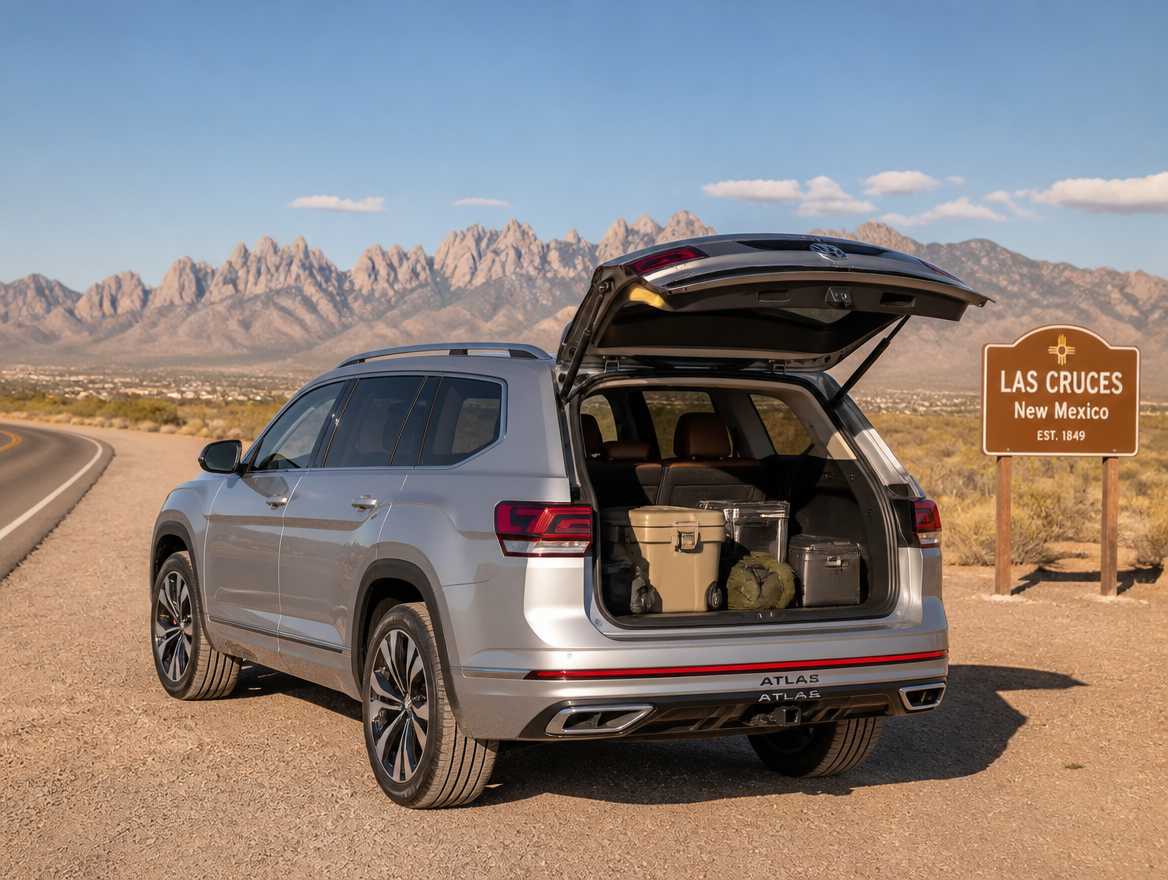
The GTI hatchback format helps here. Its four-door hatchback layout allows 34.5 cubic feet of cargo space, plenty of room for passengers and gear while you're sitting roadside waiting out a closure. Nobody buys the car for that reason, but it beats waiting in a low-slung sports car without an accessible trunk, especially in August.
See current Golf GTI inventory at Sisbarro Volkswagen if you're still deciding on trim level before a run like this.
Choosing the Right Trim for This Drive
All three 2026 Golf GTI trims handle US 70 well enough to get you to Alamogordo comfortably, yet they differ enough in comfort and chassis hardware that a short comparison is worth your time before you decide which one to test drive.
The S: 18-inch alloys, standard XDS differential lock, stability control, LED headlights. Everything the route actually requires is right there. You're not leaving anything meaningful on the table for a Las Cruces-to-Alamogordo run in the S.
The SE: Adds the panoramic sunroof and ArtVelours sport seats. The sunroof is a nice touch on a high-desert morning run, and the bolstered seats hold you more securely through side-wind correction. The comfort upgrade earns its keep.
The Autobahn: Adds the multimode Dynamic Chassis Control and Adaptive Chassis Control. If you run US 70 often and then keep climbing into the Sacramento Mountains past Alamogordo, the adjustable damping on the Autobahn earns its place. Mountain curves and desert highway in one trip ask for different suspension settings. On that combined trip, the Autobahn pays for itself.
Explore financing options to compare trims before your test drive.
Browse pre-owned Volkswagen inventory if the certified used route makes more sense for your budget.
The 2026 Golf GTI is a strong match for US 70. The pass climb suits it, the fuel economy suits the open miles, and the low center of gravity handles the basin crosswinds better than the compact footprint would lead you to expect. The tradeoff is real. It's a firm, tight car on rougher pavement, and it'll feel smaller than a midsize sedan in heavy desert gusts. Know that going in, and you've got a thoroughly capable route car.