
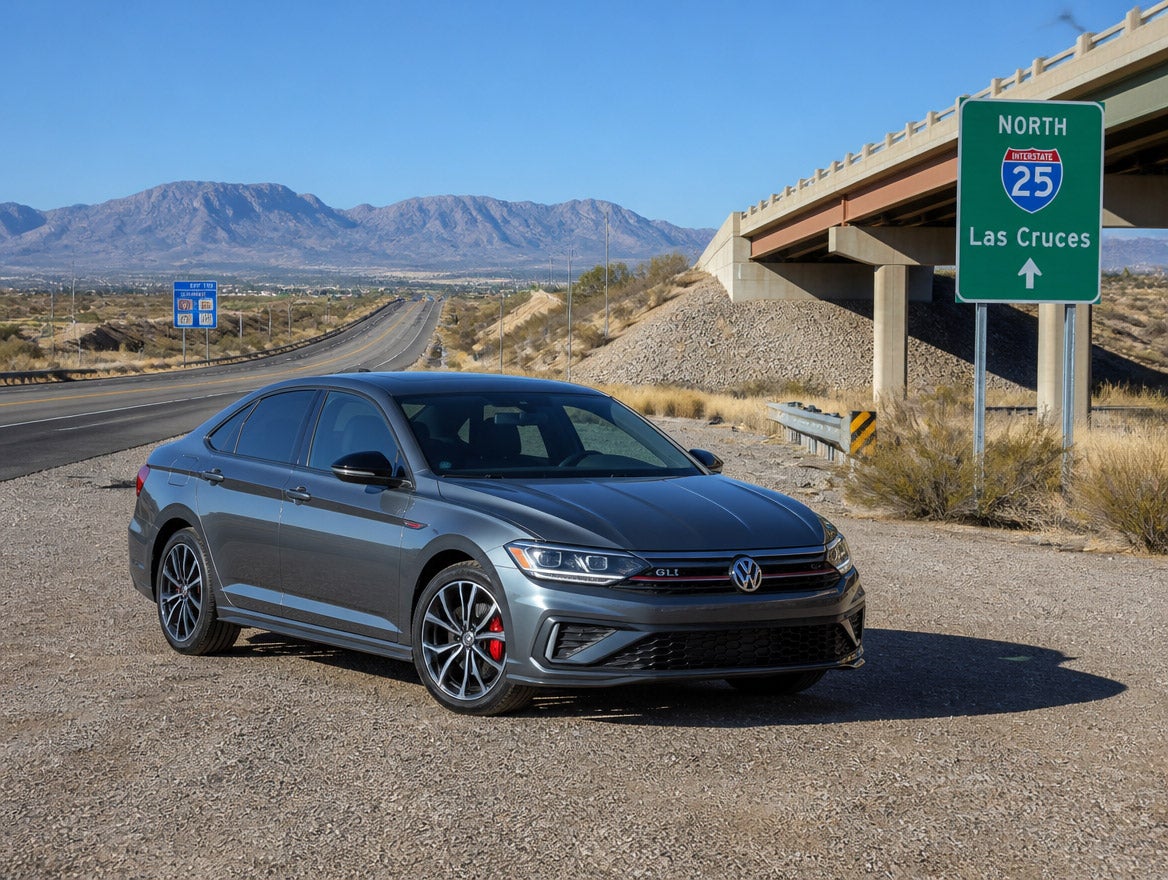
If you're running I-25 out of Las Cruces on a regular basis, you've already done the math on a lot of things. Time. Heat. Miles. The part you probably haven't sorted out yet is whether the standard 2026 Volkswagen Jetta or the Jetta GLI fits that specific drive better. They share a nameplate and a body, but the engines, suspensions, and transmissions are genuinely different. Which one's right comes down to three things. How many miles you're putting on per year, whether your commute is almost entirely highway, and how much the act of driving matters to you on a Tuesday morning.
- Pure highway efficiency: The standard Jetta earns an EPA-estimated 40 mpg highway on its 1.5L turbo, and that's hard to argue with on a long I-25 run.
- Engaged highway driver: The 228-hp 2.0L TSI and 7-speed DSG of the Jetta GLI make passing and merging effortless at desert freeway speeds.
- Ride comfort trade-off: The GLI rides 0.6 inches lower with a sport-tuned suspension. On I-25's smoother highway pavement it's composed. On rougher city surface streets, you'll feel the difference.
- The I-25 advantage of the GLI: Multi-link independent rear suspension (the standard Jetta uses a torsion beam) gives the GLI better composure through crosswind gusts and lane changes at speed.
- Fuel gap is smaller than it looks: The GLI with the DSG still returns an EPA-estimated 35 mpg highway. You give up 5 mpg, not 15.
What Actually Matters When Choosing Between These Two for a Highway Commute?
What separates these two on I-25 comes down to engine torque, rear suspension design, and transmission character rather than badge or price, and each of those pushes you a different direction depending on whether your miles are open highway or stop-and-go. Below is how those translate into a decision you'll make at the wheel.
| 2026 Jetta | 2026 Jetta GLI | Edge for I-25 if... | |
|---|---|---|---|
| Engine | 1.5L TSI, 158 hp, 184 lb-ft | 2.0L TSI, 228 hp, 258 lb-ft | GLI for confident passing; Jetta for relaxed cruising |
| Transmission | 8-speed automatic | 6-speed manual or 7-speed DSG | DSG GLI for mixed driving; manual for enthusiasts |
| EPA Highway MPG | 40 mpg | 35-36 mpg | Jetta for maximum range; GLI if 5 mpg gap is acceptable |
| Rear Suspension | Torsion beam | Multi-link independent | GLI for crosswind stability and smoother lane changes |
| Ride Height | Standard | 0.6 in. lower | Jetta for rough surface streets; GLI on open highway |
| Adaptive Damping | Not available | DCC (Comfort, Normal, Sport) | GLI lets you tune the ride each day |
| Limited-Slip Diff | Not available | VAQ electronic LSD | GLI for traction on hard acceleration |
| Front Brake Rotors | Standard disc | 13.4-in. vented disc | GLI for higher-speed stopping confidence |
| Fuel Tank | 12.8 gal | 13.2 gal | Near-identical range; GLI tank slightly larger |
Put simply, on a long, open, desert highway run, the GLI is a substantially more satisfying car to be in, no question. On a short, stop-heavy urban loop, you'll lean on the softer ride of the standard Jetta and higher fuel economy for the more practical case.
Fuel Economy Is the Strongest Card of the Standard Jetta
The EPA rates the 2026 Volkswagen Jetta at 29 mpg city and 40 mpg highway, with a 34 mpg combined figure, and that combined efficiency is exactly why the standard car makes the strongest case for a high-mileage I-25 commuter. For open-road cruising north of the city, the 40-mpg highway figure is the one that counts.
The 2026 GLI isn't far behind. Its DSG automatic version earns an EPA-estimated 26 mpg city and 35 mpg highway, while the manual returns 26 city and 36 highway. At highway speed the gap runs five mpg with the DSG, which over a genuine long-haul commute adds up to real fuel across a full year. Worth knowing here, both the 2026 Jetta and the 2026 GLI run on regular 87-octane fuel. The extra power of the GLI doesn't come with a premium fuel surcharge, and that narrows the real-world cost gap between them more than the headline mpg numbers suggest.
Explore your financing options early. Ownership cost, not just sticker position, is where the full comparison lives.
The GLI Is Built for Exactly This Kind of Road
I-25 north of Las Cruces runs fast, long, and exposed in ways a spec sheet won't capture, and that open, high-desert character rewards a chassis built to stay planted when the wind and the semis start pushing back. Wind comes across the Chihuahuan Desert with very little to slow it down. Semis generate pressure waves. Passing maneuvers at highway speed demand a car that responds when you ask it to.
The multi-link rear suspension of the GLI is the structural reason it handles those moments better than the standard Jetta. The standard car uses a torsion beam rear, a cost-effective and reliable setup for everyday driving. With the GLI, the independent rear wheels track the road surface separately, so mid-corner bumps and crosswind pushes don't unsettle the car the same way. On smooth, straight pavement you'd barely notice the difference. Over I-25's occasional expansion joints and patched surfaces at 75 mph, it's plain to feel.
The GLI also sits 0.6 inches lower with a sport-tuned suspension. Pair that with the Volkswagen DCC adaptive damping (Comfort, Normal, and Sport modes on the Autobahn trim) and you get a car that can be firm and precise when you want it or reasonably compliant when you don't. Flexibility like that matters for a commuter who faces both highway miles and Las Cruces surface streets in the same drive.
There's one real tradeoff worth stating plainly. On rougher pavement or dipped parking-lot entries, the GLI is noticeably firmer than the standard Jetta. DCC Comfort mode helps, but it doesn't erase the difference. If your commute is mostly urban stop-and-go with only occasional highway stretches, the softer setup of the standard Jetta is the more relaxed daily companion. None of that is a knock on the GLI. The question is simply which road you drive.
See What Your Current Car Is Worth
Match the Car to How You Actually Drive
The Jetta and the GLI answer two genuinely different questions, and knowing which question is yours settles the choice faster than any single spec, because one car optimizes the commute for efficiency and calm while the other optimizes it for the driver behind the wheel. In plain terms, the standard Jetta asks how to make a long commute as efficient and relaxed as possible. The GLI asks how to make that same commute something you'll actually look forward to.
For drivers who want high fuel economy, a smooth and quiet ride, and lower running costs, the 40-mpg highway and composed ride of the standard Jetta are the right answers. It's a genuinely capable highway car. Nothing apologetic about that choice.
For drivers who spend real time at speed on I-25, want confident passing power from a 228-hp engine with 258 lb-ft of torque, and appreciate a chassis tuned for the kind of open-road driving southern New Mexico actually delivers, the GLI earns its place. The VAQ limited-slip front differential, the 13.4-inch front vented brake rotors, the adaptive damping, and the multi-link rear aren't performance theater. They show up on the road you're driving. Sisbarro Volkswagen is in Las Cruces. Both models are on our lot at Sisbarro Volkswagen, and we can put you in back-to-back drives the same afternoon. A back-to-back drive will tell you more than any table. Including this one.
Frequently Asked Questions
Is the Jetta GLI too stiff for a daily I-25 commute?
Not on I-25's highway surface, no. The 2026 Jetta GLI rides 0.6 inches lower than the standard Jetta and uses a sport-tuned suspension that's firmer than the standard car's setup. On Las Cruces surface streets and rough pavement, you'll feel that firmness. Out on I-25's open highway slab, most drivers find the GLI rides well within a comfortable range, especially with the DCC adaptive damping set to Comfort mode. If your commute is primarily highway miles, the stiffness trade-off is modest. If it's mostly city driving, the softer suspension of the standard Jetta will feel more relaxed every day.
Does the 5 mpg highway gap between the Jetta and GLI actually matter for a Las Cruces commuter?
The answer depends on your annual mileage. The EPA rates the 2026 Jetta at 40 mpg highway and the 2026 GLI with DSG at 35 mpg highway, and both run on regular 87-octane fuel, so the fuel-grade cost is the same. For occasional I-25 trips, the gap is minor. For someone logging substantial daily highway miles, the difference accumulates over a year. Estimate your annual highway mileage, divide by each car's highway rating, and you've got a concrete answer for your own situation. For many Las Cruces commuters whose I-25 driving is a moderate daily stretch, the added composure of the GLI and passing confidence close the value gap faster than the fuel numbers alone suggest.