
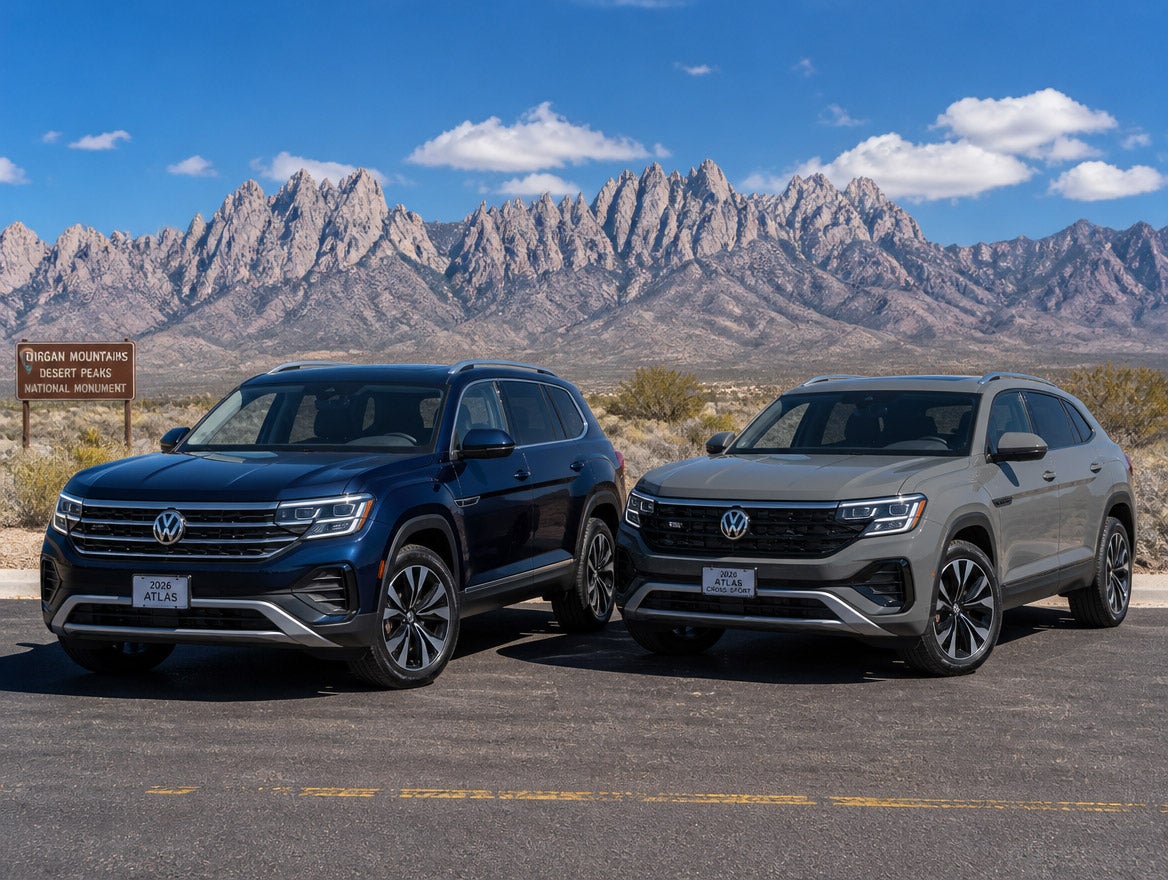
The short answer runs shorter than you'd expect. Seat more than five people on the regular, and the Atlas is your pick. If you don't, the Atlas Cross Sport hands you a bigger, more adult-friendly rear seat and more usable everyday cargo room, in a package that's a little easier to place in a garage or a Walmart parking lot on a busy Saturday.
The nuances still matter, though, and they're not what most comparison articles cover. We'll walk through the breakdown that does.
- The 2026 Atlas seats up to seven; the 2026 Atlas Cross Sport seats five, full stop.
- Both share the same 269-horsepower engine, the same 117.3-inch wheelbase, and the same maximum 5,000-lb tow rating when properly equipped.
- The second-row legroom of the Cross Sport (40.4 inches) actually beats the second row of the Atlas (37.6 inches), because no third-row seat eats into the packaging.
- Cargo behind the last row: Atlas gives you 20.6 cu ft; Cross Sport gives you 40.3 cu ft. With seats folded: Atlas 96.6 cu ft vs. Cross Sport 77.6 cu ft.
- Both earned the IIHS TOP SAFETY PICK for 2026 and the NHTSA five-star overall safety rating.
- Pick the Atlas if you need that third row now or in the foreseeable future. Pick the Cross Sport if five seats are genuinely enough and you want a more practical two-row footprint.
Households in the middle (not sure whether that third row will matter at all) should keep reading. That decision is what this guide is for.
What's the Real Difference Between These Two?
Mechanically these two are nearly identical, so the difference you'll feel every day isn't power or fuel economy but seat count and cargo layout, and the choice really comes down to how many people ride behind you and how much room you keep when everyone's aboard. The rest is body length.
Under the hood, both the 2026 Atlas and 2026 Atlas Cross Sport run the same Evo4 2.0-liter turbocharged four-cylinder producing 269 horsepower and 273 lb-ft of torque, paired to the same eight-speed automatic. Volkswagen lists the wheelbase at 117.3 inches on both. That shared foundation means identical powertrain behavior, identical fuel economy ratings (the EPA puts FWD models of both at 20 city / 27 highway), and the same tow rating of up to 5,000 lbs when properly equipped on upper trims. These are genuinely the same vehicle from the firewall forward.
Where they split is the body structure behind the B-pillar. The Atlas stretches to 200.7 inches overall length to accommodate that third row. The Cross Sport cuts 5.1 inches off the tail and lowers the roofline, giving it a sleeker profile that also happens to fit more comfortably in a standard garage.
| Spec | 2026 Atlas | 2026 Atlas Cross Sport |
|---|---|---|
| Rows / max seats | 3 rows / 7 (or 6 w/ captain's chairs) | 2 rows / 5 |
| Cargo behind last row | 20.6 cu ft | 40.3 cu ft |
| Cargo (all rows folded) | 96.6 cu ft | 77.6 cu ft |
| Row 2 legroom | 37.6 in | 40.4 in |
| Overall length | 200.7 in | 195.6 in |
| Engine | 2.0L turbo, 269 hp / 273 lb-ft | 2.0L turbo, 269 hp / 273 lb-ft |
| Tow capacity (properly equipped) | Up to 5,000 lbs | Up to 5,000 lbs |
| EPA mpg (FWD, combined) | 23 mpg | 23 mpg |
| IIHS rating | TOP SAFETY PICK | TOP SAFETY PICK |
| NHTSA overall | 5 stars | Not separately listed at time of publication |
Does the Third Row Actually Matter for Your Family?
Whether the third row earns its keep depends entirely on how often you'll fill it, and the simple audit is less about spec sheets than about being straight with yourself over who rides in the back on a normal week around Las Cruces. Do that honestly and the pick makes itself.
The third row of the Atlas really works. In practice, the layout looks like this:
- With 33.7 inches of legroom back there, it's suited for kids and smaller adults on shorter runs.
- The sliding second-row bench moves fore and aft 7.7 inches, so you can redistribute space between rows two and three depending on who's riding that day.
- When the third row is empty, though, you're left with 20.6 cubic feet of trunk space behind it. Call it compact-SUV territory. A full grocery run for a family of five fills it fast.
The Cross Sport flips that equation. With the third row removed entirely, the cargo bay behind the second row opens to 40.3 cubic feet (effectively double the usable trunk space of the Atlas when everyone's on board). And because the rear passengers of the Cross Sport aren't sharing packaging with a third row, they get 40.4 inches of legroom, nearly three inches more than Atlas row-two riders. For a family of four, that's a more comfortable daily experience, and you feel it on every trip.
See the 2026 Volkswagen Atlas Cross Sport on our lot, alongside the full three-row Atlas, and compare that cargo bay in person. You notice it the moment you load a stroller.
Browse our current Volkswagen inventory to see what's available now.
The trap to avoid is buying the Atlas "just in case." If carpool duty is a regular fact of life, or you have three kids and a dog, the third row pays for itself in flexibility immediately. If your household is solidly two adults and two kids, you're giving up everyday trunk space for a seat that may ride folded flat most of the year.
Room for the Drive to White Sands (and Everything You Pack for It)
Both SUVs handle the US-70 run east from Las Cruces to White Sands National Park with room to spare, so the deciding factor isn't capability at all but how much gear you're hauling and how many people are riding along for a full day at the dunes. The drive is an under-an-hour stretch of open highway where real-world comfort matters more than any spec-sheet number.
On that drive, both SUVs feel planted and quiet. The 269-horsepower turbo four pulls confidently through the pass with a full load, and the EPA's 27-mpg highway rating for FWD versions of both models means the return trip to town isn't a punishment at the pump. The choice shows itself when you load up. Pack for five people for a full day at the dunes and the 40.3 cubic feet of cargo space for the Cross Sport behind the second row handles boards, coolers, shoes, and bags without a Tetris session. In the Atlas, 20.6 cubic feet behind that third row makes you choose what comes and what stays home. Fold the third row and you've got an Atlas-sized cargo hold and a five-person vehicle anyway.
Families with three kids will load that third row and lean on the Atlas on the return trip when everyone's tired and space-sharing patience is short. Families of four making that same run with gear will appreciate having the trunk they need.
So Which Should You Pick?
Pick the Atlas if you need seats now or expect to soon, and pick the Cross Sport if five seats cover you and you'd rather have the roomier rear bench and bigger everyday trunk, because the two vehicles drive the same and the decision really is about seat count and how you use the cargo area day to day. We'll be direct from here.
Get the 2026 Atlas if:
- You have three or more kids, or you regularly carpool additional passengers.
- You need the occasional ability to seat six or seven, even if it's not every day.
- Extended family visits or road trips with grandparents are part of your routine.
- A larger footprint doesn't factor into your parking situation.
Get the 2026 Atlas Cross Sport if:
- Your household is consistently four or five people.
- You want the more useful daily trunk (40.3 cu ft vs. 20.6 cu ft with everyone on board).
- Your rear passengers are adults who'll notice the extra legroom.
- Garage clearance or parking-lot maneuverability matters to you.
One caveat worth naming: the Atlas is the better hedge if your family is still growing, or if you're buying a vehicle you plan to keep for seven-plus years. The Cross Sport is the better vehicle right now for a household that knows its size. Talk yourself into the third row, and you may keep it folded flat nine months out of twelve. There's nothing wrong with that flexibility, but it does cost you trunk space on every single trip where you're using it.
Explore financing options for either model with our team.
Both are excellent, and both earned IIHS TOP SAFETY PICK status for 2026. The decision really does come down to seat count and how you use your vehicle day to day, not which one sounds more capable on paper.
Come drive both back to back at Sisbarro Volkswagen. You'll know within ten minutes.
By the Sisbarro Volkswagen Team | September 2026
Frequently Asked Questions
Do the Atlas and Atlas Cross Sport have the same engine?
Yes. Both the 2026 Volkswagen Atlas and the 2026 Volkswagen Atlas Cross Sport use the Volkswagen Evo4 2.0-liter turbocharged four-cylinder engine producing 269 horsepower and 273 lb-ft of torque, paired with an eight-speed automatic transmission. Front-wheel drive is standard on base trims; 4Motion all-wheel drive is available on both models and standard on upper trims. The EPA rates FWD versions of both at 20 city and 27 highway miles per gallon.
Is the back seat of the Atlas Cross Sport actually bigger than that of the Atlas?
For second-row passengers, yes. With no third row eating into the package, the rear seat of the Atlas Cross Sport offers 40.4 inches of legroom. The second row of the Atlas provides 37.6 inches. That nearly three-inch difference is noticeable for adult passengers on longer drives. If the third row of the Atlas is in use, its legroom is 33.7 inches, which works well for children but is a tighter fit for adults on anything beyond a short trip.