
Blog / Volkswagen Atlas

Best Volkswagen Vehicles for Visiting Pumpkin Patches Around Las Cruces

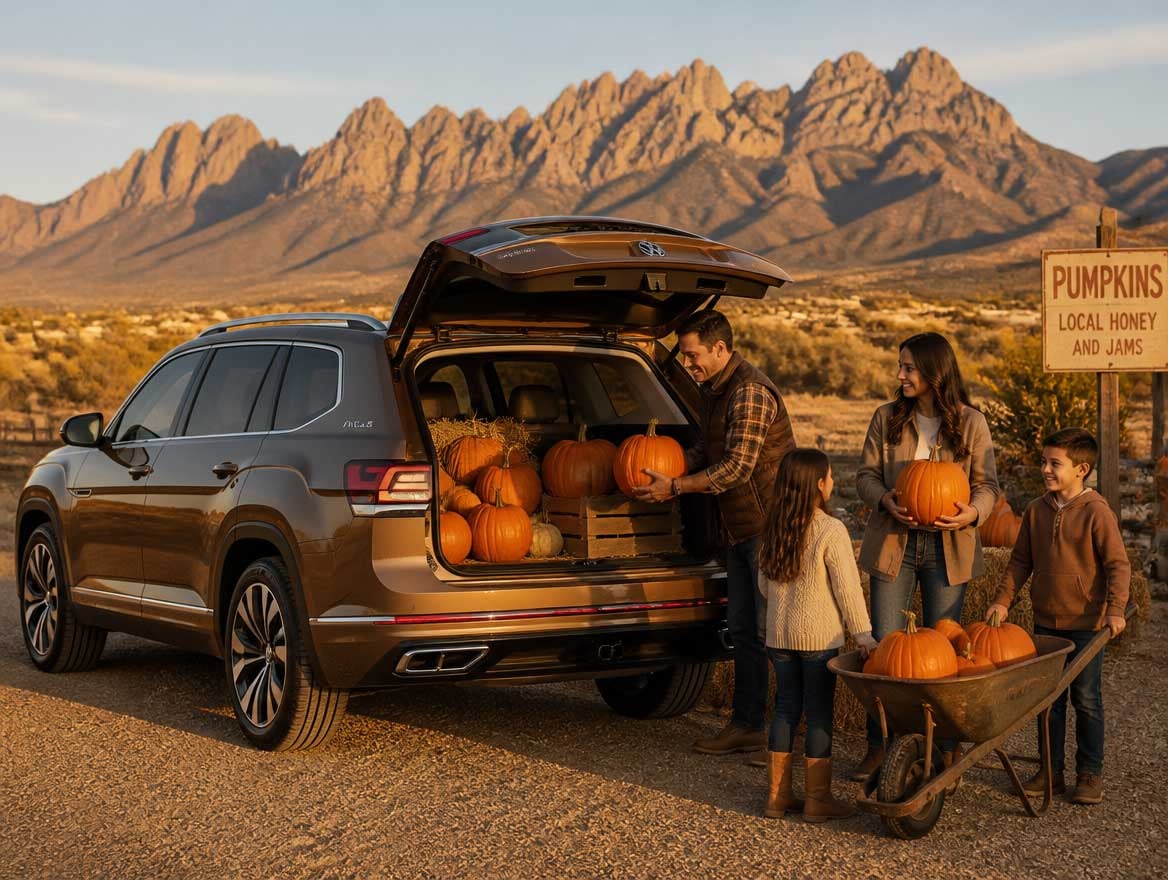
2026 Volkswagen Atlas with rear liftgate open at a Las Cruces-area pumpkin patch farm lot, pumpkins loaded in cargo area, Organ Mountains in the distance

October in the Mesilla Valley is a good stretch to be outside, and if you've done a pumpkin-patch run before, you already know the question that decides your afternoon isn't "which pumpkin," it's whether all of it fits in the car. The 2026 Volkswagen Atlas is our top pick for families doing a full pumpkin-patch day out here. Three rows, up to 96.6 cubic feet of cargo when you need it, and enough headroom that a giant pumpkin in the back doesn't turn into a Tetris emergency. Not every household needs a full three-row hauler, though, so we've ranked all three of our 2026 Volkswagen SUVs against what this outing actually demands. Think farm-lot parking, sticky-fingered kids, awkward pumpkin shapes, and a warm October afternoon on the drive home.

The Ranking at a Glance

RankPickBest ForStandout Spec
1AtlasBig families, max cargo96.6 cu ft cargo (all rows folded); 7 seats
2TiguanFamilies of 4-5, practical balance69.8 cu ft cargo (seats folded); 5 seats
3TaosCouples, solo parents, lighter loads65.9 cu ft cargo (FWD, seats folded); 5 seats

1. The Atlas: Built for the Full Chaotic Pumpkin-Patch Family Day

The Atlas earns the top spot because it hauls a full family and a full pumpkin load at the same time, with three rows, seven seats, and a cargo floor that swallows what you figured wouldn't fit, though its size is the price you pay for all that room. Volkswagen rates the 2026 Atlas at 20.6 cubic feet behind the third row (enough for a stroller and a medium pumpkin already), 55.5 cubic feet with the third row folded, and a flat-loading 96.6 cubic feet when both rear rows go down. What that means on the day is simple. You can haul the kids in the second row, load the third-row floor with gourds and corn stalks, and still have room for the cooler and the face-painting cape your six-year-old won't take off.

The 4MOTION AWD system is available across the lineup and comes standard on upper trims. It matters less for the Mesilla Valley Maze in Fairacres, where the lot is relatively flat, and more if you end up on softer ground after a late-monsoon shower. October in southern New Mexico still catches the tail of monsoon season now and then, and a gravel farm lot after rain is a different surface than dry caliche. The 2026 Atlas is powered by a 2.0-liter turbocharged four-cylinder rated at 269 horsepower and 273 lb-ft of torque, paired with an eight-speed automatic. There's enough pull there to make the I-10 leg home feel relaxed under a full load.

One tradeoff worth naming is the size. At 200.7 inches bumper to bumper, the Atlas can feel tight on an improvised farm lot. It parks fine in standard spaces, though on a busy Saturday at a pumpkin patch somebody may pull a pickup in beside you, and you'll be glad for those front and rear parking sensors.

See 2026 Atlas availability on our lot

Explore Financing Options

2. The Tiguan: The Smarter Pick for a Family of Four or Five

For a family of four or five, the Tiguan is the smarter pick than the Atlas, since the 2026 redesign dropped its optional third row and handed it a cargo floor that lays flatter and loads cleaner, and for a pumpkin-patch day that lost seat row is a fair trade rather than the setback it sounds like. The 2026 Volkswagen Tiguan delivers 33.8 cubic feet behind the rear seats and 69.8 cubic feet with the seats folded, and that near-flat load floor is genuinely easy to slide a big, lumpy pumpkin across without worrying about the seat-fold mechanism.

For a family of four (two adults, two kids in car seats), the Tiguan is the more natural size, though a carful of grandparents plus kids will fill every seat. At 184.4 inches long, farm-lot parking is noticeably less stressful. The SEL Turbo trim is EPA-rated at 29 highway MPG with AWD, which makes the round trip from Las Cruces to La Union Maze and back an efficient one. Every 2026 Tiguan comes standard with forward collision warning, automatic emergency braking, blind-spot monitoring, and rear cross-traffic alert. All of that active safety tech runs whether you're on I-10 or picking your way up the gravel approach road to a farm.

The tradeoff against the Atlas is passenger count. Five is the ceiling for the Tiguan.

Buying caution: Cargo numbers shift between the FWD and AWD Taos trims. If you're picking a Taos mainly for its cargo space and you plan to add AWD, know that the 4MOTION configuration drops the behind-seat figure to 24.9 cubic feet (down from 27.9 on FWD models). For big pumpkin ambitions, that gap's worth weighing. Size up to the Tiguan if cargo matters to you more than the smaller footprint.

Pros and Cons: Atlas vs. Tiguan vs. Taos for Pumpkin-Patch Day

ProsCons
Atlas96.6 cu ft max cargo, 7 seats, towing-capable (5,000 lbs properly equipped), 4MOTION AWD availableLargest footprint (200.7 in); tighter on improvised farm lots
TiguanNear-flat cargo floor at 69.8 cu ft, 5-seat practicality, 29 hwy MPG (SEL Turbo AWD), easier parkingNo third row; five-passenger ceiling
TaosMost manageable size, EPA-rated 33 hwy MPG (AWD), easy to park anywhereSmallest cargo (24.9 cu ft seats-up with AWD); not rated for towing

3. The Taos: For the Light-Loading Las Cruces Trip

The Taos is the right call when the pumpkin run is a lighter affair, two adults, a toddler, and a plan to come home with three pumpkins and one big decorative gourd, though it trades cargo room and towing for its easy size. The 2026 Volkswagen Taos carries 27.9 cubic feet behind the rear seats in FWD trim (or 24.9 cubic feet with 4MOTION AWD), and folds flat to 65.9 cubic feet (FWD) or 60.2 cubic feet (AWD) when the rear seats go down. For a light haul, that's plenty.

The EPA rates the 2026 Taos AWD at 25 city and 33 highway MPG, the most efficient option in our Volkswagen SUV lineup. That efficiency matters if you're also running the kids to NMSU events or making the El Paso corridor commute during the week. The Taos rides on a 1.5-liter turbocharged four-cylinder with the 4MOTION AWD option available on SE and SEL trims, paired with an eight-speed DSG automatic for crisp shifts. One firm limit's worth flagging. The Taos isn't rated for towing, so if the trip ends with hauling a hay bale home for the front porch, you'll want the Atlas or Tiguan instead.

Parking is where the Taos earns easy points at a crowded October farm. The Taos is the easiest of the three to slot into whatever space remains.

The Atlas Is Still Our Top Pick for Pumpkin-Patch Day

The Atlas stays our top pick because the cargo math works in its favor, giving you 96.6 cubic feet of flat load space, seven seats that configure several ways, and a third row that folds so you carry the kids and the pumpkins without choosing between them. For the Mesilla Valley Maze in Fairacres (open October 3 through October 25, 2026), where you might come home with a hayride memory, three carved-ready pumpkins, a corn-stalk bundle, and two sugar-crashed kids in the back, the Atlas is the one that makes you glad you planned ahead. The Tiguan is the right call if your group is smaller and you want a more parkable SUV with a genuinely excellent cargo floor. The Taos earns its place when the trip is lighter and fuel efficiency is part of the equation.

Come see all three on our lot. Open the liftgate, load in whatever you'd actually haul, and see which one fits your October.
Sisbarro Volkswagen

1115 S Valley Dr, Las Cruces, NM 88005

(575) 319-9131


Posted in:

Related Posts

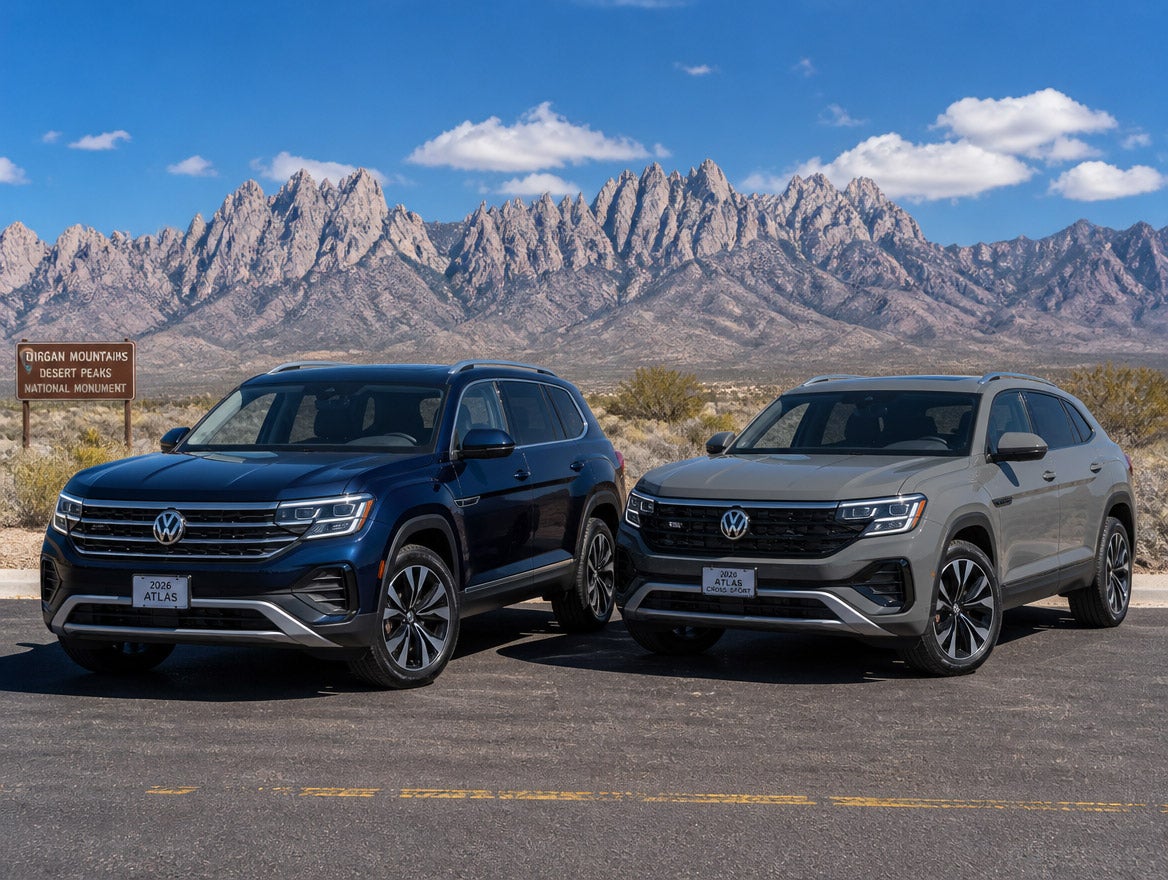
2026 Volkswagen Atlas and 2026 Volkswagen Atlas Cross Sport side by side on a southern New Mexico desert highway with the Organ Mountains behind them

Volkswagen Atlas vs. Atlas Cross Sport for Las Cruces Families

In this article What's the Real Difference Between These Two? Does the Third Row Actually Matter for Your Family? Room for the Drive to White Sands (and Everything You Pack for It) So Which Should You Pick? The short answer runs shorter than you'd expect. Seat more than five people on the regular, and the Atlas is your pick. If you don't, the Atlas Cross Sport hands you a bigger, more adult-friendly rear seat and more usable everyday cargo room, in a package that's a little easier to place in a garage or a Walmart parking lot on a busy Saturday. The nuances still matter, though, and they're not what most comparison articles cover. We'll walk through the breakdown that does. The short version The 2026 Atlas seats up to seven; the 2026 Atlas Cross Sport seats five, full stop. Both share the same 269-horsepower engine, the same 117.3-inch wheelbase, and the same maximum 5,000-lb tow rating when properly equipped. The second-row legroom of the Cross Sport (40.4 inches) actually beats the second row of the Atlas (37.6 inches), because no third-row seat eats into the packaging. Cargo behind the last row: Atlas gives you 20.6 cu ft; Cross Sport gives you 40.3 cu ft. With seats folded: Atlas 96.6 cu ft vs. Cross Sport 77.6 cu ft. Both earned the IIHS TOP SAFETY PICK for 2026 and the NHTSA five-star overall safety rating. Pick the Atlas if you need that third row now or in the foreseeable future. Pick the Cross Sport if five seats are genuinely enough and you want a more practical two-row footprint. Households in the middle (not sure whether that third row will matter at all) should keep reading. That decision is what this guide is for. the 2026 Volkswagen Atlas What's the Real Difference Between These Two? Mechanically these two are nearly identical, so the difference you'll feel every day isn't power or fuel economy but seat count and cargo layout, and the choice really comes down to how many people ride behind you and how much room you keep when everyone's aboard. The rest is body length. Under the hood, both the 2026 Atlas and 2026 Atlas Cross Sport run the same Evo4 2.0-liter turbocharged four-cylinder producing 269 horsepower and 273 lb-ft of torque, paired to the same eight-speed automatic. Volkswagen lists the wheelbase at 117.3 inches on both. That shared foundation means identical powertrain behavior, identical fuel economy ratings (the EPA puts FWD models of both at 20 city / 27 highway), and the same tow rating of up to 5,000 lbs when properly equipped on upper trims. These are genuinely the same vehicle from the firewall forward. Where they split is the body structure behind the B-pillar. The Atlas stretches to 200.7 inches overall length to accommodate that third row. The Cross Sport cuts 5.1 inches off the tail and lowers the roofline, giving it a sleeker profile that also happens to fit more comfortably in a standard garage. Spec 2026 Atlas 2026 Atlas Cross Sport Rows / max seats 3 rows / 7 (or 6 w/ captain's chairs) 2 rows / 5 Cargo behind last row 20.6 cu ft 40.3 cu ft Cargo (all rows folded) 96.6 cu ft 77.6 cu ft Row 2 legroom 37.6 in 40.4 in Overall length 200.7 in 195.6 in Engine 2.0L turbo, 269 hp / 273 lb-ft 2.0L turbo, 269 hp / 273 lb-ft Tow capacity (properly equipped) Up to 5,000 lbs Up to 5,000 lbs EPA mpg (FWD, combined) 23 mpg 23 mpg IIHS rating TOP SAFETY PICK TOP SAFETY PICK NHTSA overall 5 stars Not separately listed at time of publication The single deciding factor: do you currently seat, or expect to regularly seat, more than five people? If yes, buy the Atlas. If no, the rear-seat and cargo layout of the Cross Sport will serve you better in day-to-day use. Does the Third Row Actually Matter for Your Family? Whether the third row earns its keep depends entirely on how often you'll fill it, and the simple audit is less about spec sheets than about being straight with yourself over who rides in the back on a normal week around Las Cruces. Do that honestly and the pick makes itself. The third row of the Atlas really works. In practice, the layout looks like this: With 33.7 inches of legroom back there, it's suited for kids and smaller adults on shorter runs. The sliding second-row bench moves fore and aft 7.7 inches, so you can redistribute space between rows two and three depending on who's riding that day. When the third row is empty, though, you're left with 20.6 cubic feet of trunk space behind it. Call it compact-SUV territory. A full grocery run for a family of five fills it fast. The Cross Sport flips that equation. With the third row removed entirely, the cargo bay behind the second row opens to 40.3 cubic feet (effectively double the usable trunk space of the Atlas when everyone's on board). And because the rear passengers of the Cross Sport aren't sharing packaging with a third row, they get 40.4 inches of legroom, nearly three inches more than Atlas row-two riders. For a family of four, that's a more comfortable daily experience, and you feel it on every trip. See the 2026 Volkswagen Atlas Cross Sport on our lot, alongside the full three-row Atlas, and compare that cargo bay in person. You notice it the moment you load a stroller. Browse our current Volkswagen inventory to see what's available now. The trap to avoid is buying the Atlas "just in case." If carpool duty is a regular fact of life, or you have three kids and a dog, the third row pays for itself in flexibility immediately. If your household is solidly two adults and two kids, you're giving up everyday trunk space for a seat that may ride folded flat most of the year. Room for the Drive to White Sands (and Everything You Pack for It) Both SUVs handle the US-70 run east from Las Cruces to White Sands National Park with room to spare, so the deciding factor isn't capability at all but how much gear you're hauling and how many people are riding along for a full day at the dunes. The drive is an under-an-hour stretch of open highway where real-world comfort matters more than any spec-sheet number. On that drive, both SUVs feel planted and quiet. The 269-horsepower turbo four pulls confidently through the pass with a full load, and the EPA's 27-mpg highway rating for FWD versions of both models means the return trip to town isn't a punishment at the pump. The choice shows itself when you load up. Pack for five people for a full day at the dunes and the 40.3 cubic feet of cargo space for the Cross Sport behind the second row handles boards, coolers, shoes, and bags without a Tetris session. In the Atlas, 20.6 cubic feet behind that third row makes you choose what comes and what stays home. Fold the third row and you've got an Atlas-sized cargo hold and a five-person vehicle anyway. Per IIHS: Both the 2026 Volkswagen Atlas and 2026 Volkswagen Atlas Cross Sport earned the TOP SAFETY PICK designation, achieving Good ratings in the small overlap front, updated moderate overlap front, and updated side tests, with standard LED headlights rated Good across all trims. Families with three kids will load that third row and lean on the Atlas on the return trip when everyone's tired and space-sharing patience is short. Families of four making that same run with gear will appreciate having the trunk they need. So Which Should You Pick? Pick the Atlas if you need seats now or expect to soon, and pick the Cross Sport if five seats cover you and you'd rather have the roomier rear bench and bigger everyday trunk, because the two vehicles drive the same and the decision really is about seat count and how you use the cargo area day to day. We'll be direct from here. Get the 2026 Atlas if: You have three or more kids, or you regularly carpool additional passengers. You need the occasional ability to seat six or seven, even if it's not every day. Extended family visits or road trips with grandparents are part of your routine. A larger footprint doesn't factor into your parking situation. Get the 2026 Atlas Cross Sport if: Your household is consistently four or five people. You want the more useful daily trunk (40.3 cu ft vs. 20.6 cu ft with everyone on board). Your rear passengers are adults who'll notice the extra legroom. Garage clearance or parking-lot maneuverability matters to you. One caveat worth naming: the Atlas is the better hedge if your family is still growing, or if you're buying a vehicle you plan to keep for seven-plus years. The Cross Sport is the better vehicle right now for a household that knows its size. Talk yourself into the third row, and you may keep it folded flat nine months out of twelve. There's nothing wrong with that flexibility, but it does cost you trunk space on every single trip where you're using it. Explore financing options for either model with our team. Both are excellent, and both earned IIHS TOP SAFETY PICK status for 2026. The decision really does come down to seat count and how you use your vehicle day to day, not which one sounds more capable on paper. Come drive both back to back at Sisbarro Volkswagen. You'll know within ten minutes. By the Sisbarro Volkswagen Team | September 2026 Frequently Asked Questions Do the Atlas and Atlas Cross Sport have the same engine? Yes. Both the 2026 Volkswagen Atlas and the 2026 Volkswagen Atlas Cross Sport use the Volkswagen Evo4 2.0-liter turbocharged four-cylinder engine producing 269 horsepower and 273 lb-ft of torque, paired with an eight-speed automatic transmission. Front-wheel drive is standard on base trims; 4Motion all-wheel drive is available on both models and standard on upper trims. The EPA rates FWD versions of both at 20 city and 27 highway miles per gallon. Is the back seat of the Atlas Cross Sport actually bigger than that of the Atlas? For second-row passengers, yes. With no third row eating into the package, the rear seat of the Atlas Cross Sport offers 40.4 inches of legroom. The second row of the Atlas provides 37.6 inches. That nearly three-inch difference is noticeable for adult passengers on longer drives. If the third row of the Atlas is in use, its legroom is 33.7 inches, which works well for children but is a tighter fit for adults on anything beyond a short trip. Value Your Trade-In Toward an Atlas or Atlas Cross Sport Sisbarro Volkswagen 1115 S Valley Dr, Las Cruces, NM 88005 (575) 319-9131

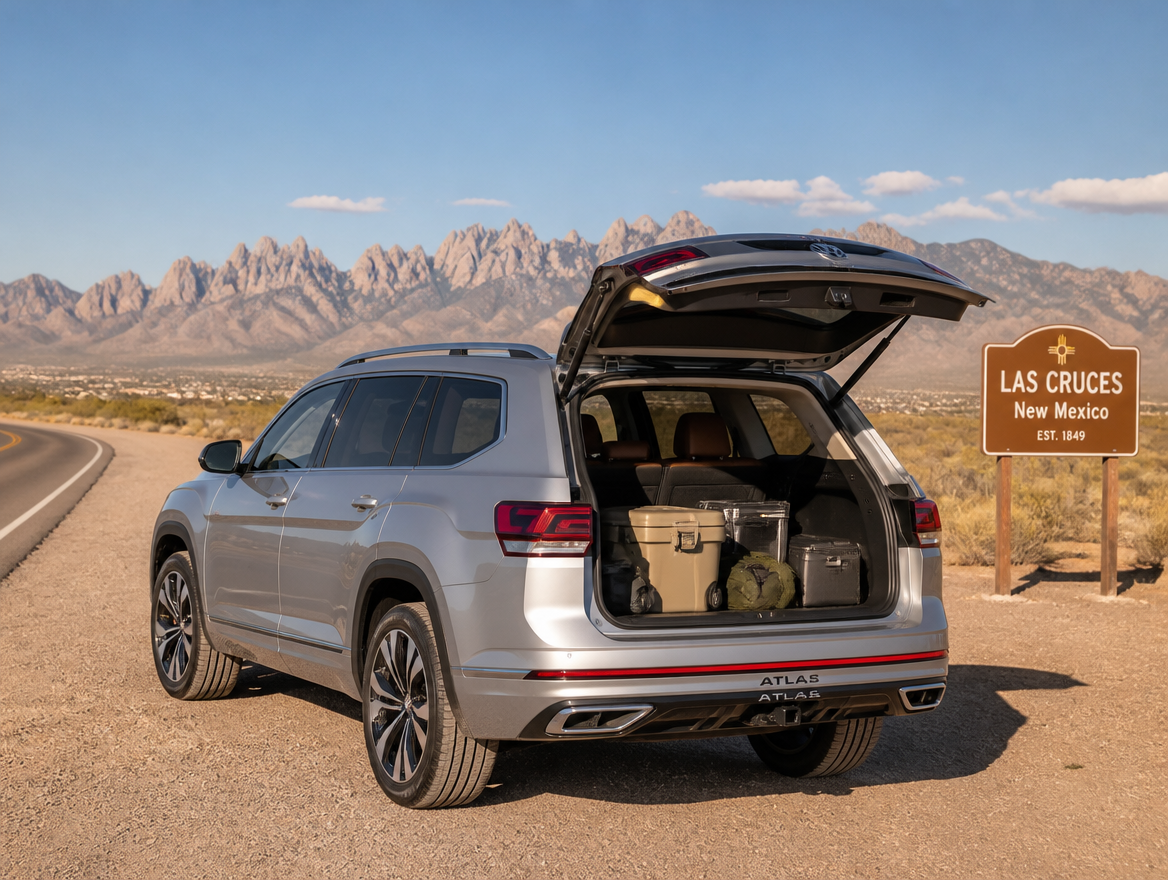
2026 Volkswagen Atlas rear cargo area open on a desert highway near Las Cruces with the Organ Mountains in the background

Volkswagen ID. Buzz vs. Atlas for Large Families

In this article What You Need Before You Start Setting Up Both Vehicles for Seven Passengers Cargo Setup: Which Layout to Use When Your Print-and-Go Family Setup Recap Both Volkswagen vehicles seat seven. That's where the easy part ends. Families walking our lot rarely ask which one is bigger. They ask how to set the thing up so everyone fits and the stroller, the soccer gear, or the trailer still comes along. Your answer shifts depending on which vehicle you're sitting in, and a bad configuration turns a trip to White Sands into a Tetris argument in the parking lot. Row by row, we'll walk you through the seat, cargo, and tow setup for both vehicles, so you leave knowing exactly what to do before the family piles in. The 2026 Volkswagen Atlas The single biggest configuration difference is this. The Atlas gives you a folding second row that stays in the car, while the 2025 ID. Buzz gives you a removable third row that comes out entirely (each seat section weighs around 60 pounds, so plan where you're storing it). What You Need Before You Start Every family setup starts with a quick checklist you can run before you even open a door, and it takes two minutes to confirm the things that decide whether the rest of the process goes smoothly. Run through these first. Item to confirm 2026 Atlas 2025 ID. Buzz Number of passengers Up to 7 Up to 7 Third-row entry method Second row tilts/slides forward Third-row seats remove or second-row captain's chairs tip forward Child-seat LATCH sets, row 2 3 (bench) or 2 (captain's chairs) Available in row 2 Towing hitch included SE: no factory hitch (2,000 lb aftermarket limit); SE w/ Technology+: standard hitch, up to 5,000 lbs RWD: up to 2,600 lbs; AWD 4Motion: up to 3,500 lbs Charging/fuel type 87 octane gasoline Electric, 91-kWh battery EPA efficiency 20 city / 27 hwy (FWD) 234 miles estimated range (RWD) Two rows in this table deserve a closer look before you touch a seat. Atlas trim level changes your towing story a great deal. The base SE tops out at 2,000 pounds with an aftermarket hitch, while any SE with Technology or above comes with a factory hitch and the full 5,000-pound braked rating. Second, the ID. Buzz EPA range of 234 miles (RWD) or 231 miles (AWD 4Motion) is the number to know for any day trip south on US-70. Setting Up Both Vehicles for Seven Passengers Loading all seven seats is the workhorse configuration, the full house with everyone buckled and the trip underway, and it's the setup that rewards a little planning up front. Start here. Step 1: Load the second row first in the Atlas. The Atlas second row is a 60/40 split-folding bench. It tilts and slides forward even with a forward-facing child safety seat attached to the LATCH anchors. Slide both sections forward slightly to open the third-row entry path before anyone tries to climb back there. Step 2: Confirm Atlas third-row legroom before you commit. Volkswagen lists 33.7 inches of third-row legroom and 38.3 inches of headroom. That's genuinely livable for kids and shorter adults on a drive to the Organ Mountains-Desert Peaks National Monument. We'll be straight with you, though. A six-foot adult back there on a two-hour interstate stretch will notice it. Set expectations. Step 3: In the ID. Buzz, verify your trim's row-two setup. The 2025 ID. Buzz sold in the U.S. comes in a 2+2+3 seven-seat layout, and two captain's chairs in the second row is the standard North American configuration. Those captain's chairs tip forward to open third-row access. The aisle between them runs narrower than a traditional minivan sliding door, so load passengers before bags. Step 4: Confirm the ID. Buzz third row is actually installed. The third-row sections of the ID. Buzz are removable, and if someone stored them before your test drive, the car shows up as a five-seater. Each section weighs about 60 pounds. If they're in, check that both sides are locked down with the seat latches before anyone sits there. Step 5: Install child safety seats in row two on either vehicle. Our current inventory includes units on which our team can show you the LATCH anchor positions in person. On the Atlas, the second-row bench offers three complete LATCH sets, though IIHS notes the lower anchors sit deeper in the seat cushion and require more effort to clip. The captain's chairs of the ID. Buzz have exposed lower anchors, and families we talk to consistently find these easier to clip quickly. Step 6: Settle the range or fuel question before departure. The 2026 Atlas runs on regular 87-octane fuel, EPA-estimated at 20 city / 27 highway on FWD trims. For the ID. Buzz, the EPA rates the RWD Pro S at 234 miles of range and the AWD 4Motion at 231 miles. Our high-desert elevation (roughly 3,900 feet) and summer heat can trim both fuel economy and EV range, so plan an ID. Buzz charging stop on any round trip beyond 100 miles. Explore Financing Options Step most families get wrong: Skipping the tow hitch conversation until they're ready to buy. On the Atlas, the standard factory hitch only comes with SE with Technology trim and above. On the ID. Buzz, the AWD 4Motion is your towing option at up to 3,500 pounds when properly equipped. Neither vehicle hitch situation is complicated once you know it. Discovering it after you've already configured the rest of the purchase is a frustrating surprise. For families who tow a small camper or a utility trailer: the 2026 Atlas with SE with Technology trim or above is the straightforward path, rated at up to 5,000 pounds when properly equipped. The 2025 ID. Buzz tops out at 3,500 pounds on the AWD 4Motion, adequate for a lightweight trailer but short of the ceiling of the Atlas. Cargo Setup: Which Layout to Use When The cargo story between these two vehicles runs genuinely counterintuitive, and it's worth mapping out before you decide. The layouts break down this way. Scenario Best Atlas layout Best ID. Buzz layout Load-bearing difference 7 passengers, minimal gear All rows up All rows up, third row locked in Atlas: 20.6 cu ft behind row 3. ID. Buzz: 18.6 cu ft behind row 3 5 passengers + weekend gear Third row folded 50/50 Third row tilted/removed Atlas: 55.5 cu ft behind row 2. ID. Buzz: 75.5 cu ft (third row out) Cargo-only or camping mode Both rear rows folded flat Third row removed, second row folded Atlas: 96.6 cu ft max. ID. Buzz: up to 145.5 cu ft max Bike/large item transport Third row folded flat Third row removed, second row folded ID. Buzz flat load floor is easier; Atlas has a slight step The advantage of the ID. Buzz kicks in once you pull that third row out entirely. At up to 145.5 cubic feet of maximum cargo volume, it out-hauls the 96.6 cubic-foot maximum of the Atlas. There's a real tradeoff, though. Those 60-pound seat sections need to live somewhere when they're not in the vehicle. Browse the 2026 Atlas for families who need the cargo flexibility of folding rows without the extraction logistics. Your Print-and-Go Family Setup Recap Run this in under two minutes before every trip, and you'll catch the small stuff that otherwise strands the stroller in the driveway. Both lists below cover it. Atlas checklist: Second row: tilted forward to confirm row-three entry path is clear Child seats: LATCH clipped, top tether attached to anchor behind seat Towing: hitch confirmed for your trim level (SE with Technology+ for 5,000-lb rating, properly equipped) Fuel: regular 87-octane, EPA-estimated 20 city / 27 highway (FWD) Safety: IIHS named the 2026 Atlas a TOP SAFETY PICK+, its highest honor, and NHTSA awarded it five out of five stars overall ID. Buzz checklist: Third row: both sections locked in or both fully removed and stored (not halfway) Captain's chairs: tipped forward to confirm third-row access before passengers board Child seats: LATCH anchors clipped in row two, tether to anchor on row-three seat frame Charging: EPA-estimated 234 miles (RWD) / 231 miles (AWD); plan charging for runs past 100 miles from Las Cruces Towing: confirm AWD 4Motion for up to 3,500-lb rating, properly equipped Talk to our finance team about which trim puts your preferred configuration within reach. Trim level is the decision that unlocks the tow rating along with the seat-heating and ventilation features on both vehicles, so it's worth a conversation before you finalize anything. Both vehicles carry your family well. The Atlas fits more naturally into a routine that mixes passengers, the occasional trailer, and a gas station on every corner. The 2025 ID. Buzz rewards families who want a larger maximum cargo volume, a genuinely impressive third row, and the flexibility of all-electric driving. It's built for those who can charge at home or along their regular routes. Neither is a compromise. They're just answers to different questions. Frequently Asked Questions Does the Volkswagen ID. Buzz have a 2026 model year? No. Volkswagen confirmed that the ID. Buzz skips the 2026 model year in the U.S. The model currently on sale is the 2025 ID. Buzz. A refreshed 2027 version is planned. If you're shopping now, the 2025 ID. Buzz is the current vehicle our team can help you configure and finance. Which Volkswagen is better for a family that needs to tow a trailer? For heavier towing, the 2026 Atlas with SE with Technology trim or above is the stronger option, rated at up to 5,000 pounds when properly equipped and coming with a factory hitch standard on those trims. The 2025 ID. Buzz AWD 4Motion is rated at up to 3,500 pounds when properly equipped. Both are capable of pulling a smaller utility or camping trailer; the Atlas simply has the higher ceiling and a lower entry point for the factory hitch. Value Your Trade-In Sisbarro Volkswagen 1115 S Valley Dr, Las Cruces, NM 88005 (575) 319-9131

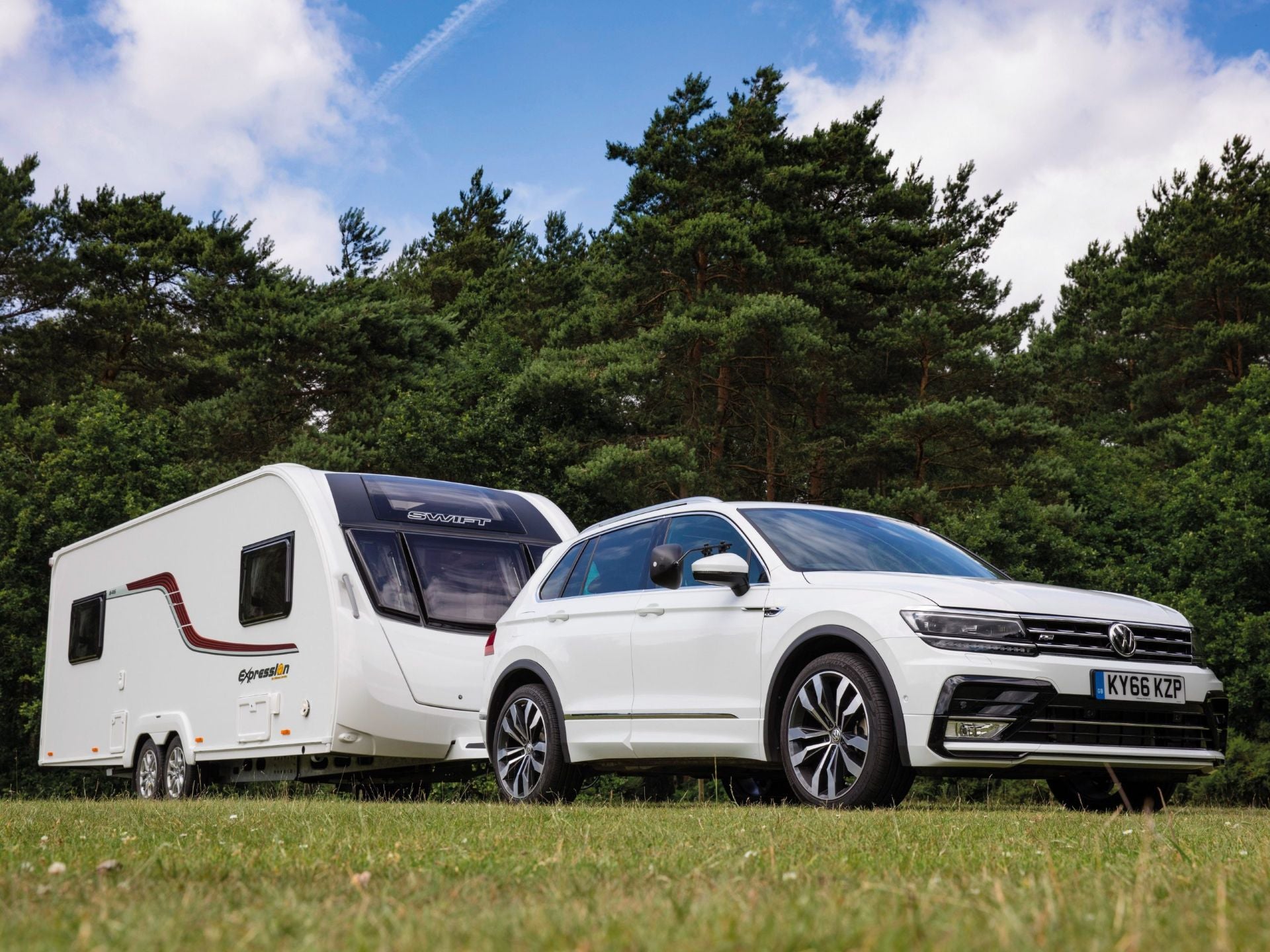
The Powerful Volkswagen Tiguan Towing A Long, White Trailer With Ease

How Much Can a Volkswagen Tow?

Sometimes, the trunk or cargo hold isn’t enough, and attaching a roof rack isn’t sufficient either because what you want to take is too large to pack in or on your vehicle. Sometimes, what you want to take is even a temporary home or a motorized toy for trail, snow, or water. Big trailers need a towing-focused vehicle, but what if you're towing something light? Can you do it with a regular Volkswagen? Possibly. Sisbarro Volkswagen discusses what you can and cannot tow with your Volkswagen. Cars used to be built differently, mostly with body-on-frame construction, where the chassis handled all loads, and the body was simply bolted on. This allowed a single model line to offer a range of body styles, including sedans, coupes, convertibles, and station wagons. Volkswagen, for example, built multiple models, including the Beetle, Bus, Fastback, Kammback, and Karman Ghia, on mostly the same chassis. Towing ability was common among these vehicles because load impacts were absorbed by the chassis alone. Rear-wheel drive also helped by limiting trailer loads to the frame between the rear axle and the hitch. Even the Beetle could tow up to 1,500 pounds, though steep inclines challenged its engine. Today, most cars and crossovers are built using unibody construction, in which the body itself serves as the frame.  There are several advantages of this, including weight reduction, which improves both performance and efficiency, and better handling because the body has less flex, enabling a more comfortable and quieter ride. Front wheel drive architecture in which the engine is turned sideways with the transmission beside it (instead of behind) and the crankshaft essentially lines up with the front axles.  Almost every all-wheel-drive vehicle uses a front-wheel-drive architecture, including all modern Volkswagen models. One drawback of unibody construction is that it limits towing ability. This is because the towing pull stress is now distributed across the entire vehicle body, and the front-wheel-drive architecture exacerbates the problem. This doesn’t mean that no unibody vehicles can tow, but most will tow less than similar-sized body-on-frame vehicles, which are now mostly pickup trucks and SUVs on pickup-truck chassis. This may lead you to wonder if any VW vehicles can tow at all.  The answer is some can, and some cannot. Cannot Tow In general, towing increases with the vehicle size. Thus, it is the smaller models that are not recommended for towing of any kind.  These include: Golf GTI and Golf R Jetta and Jetta GLI Taos Can Tow The Tiguan, when fitted with a Class 1 hitch, can tow up to 1,500 pounds with FWD and 1,800 pounds with AWD.  This may be enough for a compact camping trailer with room for one double bed and a small kitchen.  It may also be enough for a trailer containing a single mid-size ATV or two dirt bikes. With a properly installed hitch, the Atlas and Atlas CrossSport are both rated to tow up to 5,000 pounds regardless of whether they are FWD or AWD.  This is enough for most pop-up campers and light travel trailers from 15 to 20 feet that sleep four and have amenities like a bathroom and even a single slide-out to expand the living space.  Some small boats and trailers may also come under this figure. Can Tow But… Electric motors' high torque aids towing; the ID.4 has a max capacity of 2,200–2,700 pounds, depending on the model, and the ID.Buzz can tow 3,500 pounds with AWD and 2,700 with FWD. Range reduction limits practicality for long-distance towing. Towing reduces a vehicle’s efficiency—but it’s more critical for EVs because they have limited stored energy. The larger 82kWh battery of the ID.4 holds about 2.4 gallons of gas, and the electric motor’s efficiency enables up to 291 miles on a full charge, but trailers can reduce this range. Know Your GCWR Knowing the trailer weight isn't enough for safe towing; you must also consider your model’s Gross Combined Weight Rating (GCWR), the maximum total combined weight of your vehicle and trailer, including passengers, cargo, and fuel. Exceeding GCWR can cause brake failure and damage. For example, the Atlas's GCWR is about 9,000–10,000 pounds, depending on the model. If fully loaded with passengers, cargo, and additional trailer cargo, you may go over the limit. It's best to weigh your vehicle and trailer at a public scale and add passenger and cargo weight before towing. If you have something you want to tow with your Volkswagen, ask the experts at the Sisbarro Volkswagen Service Department about the best steps to take.