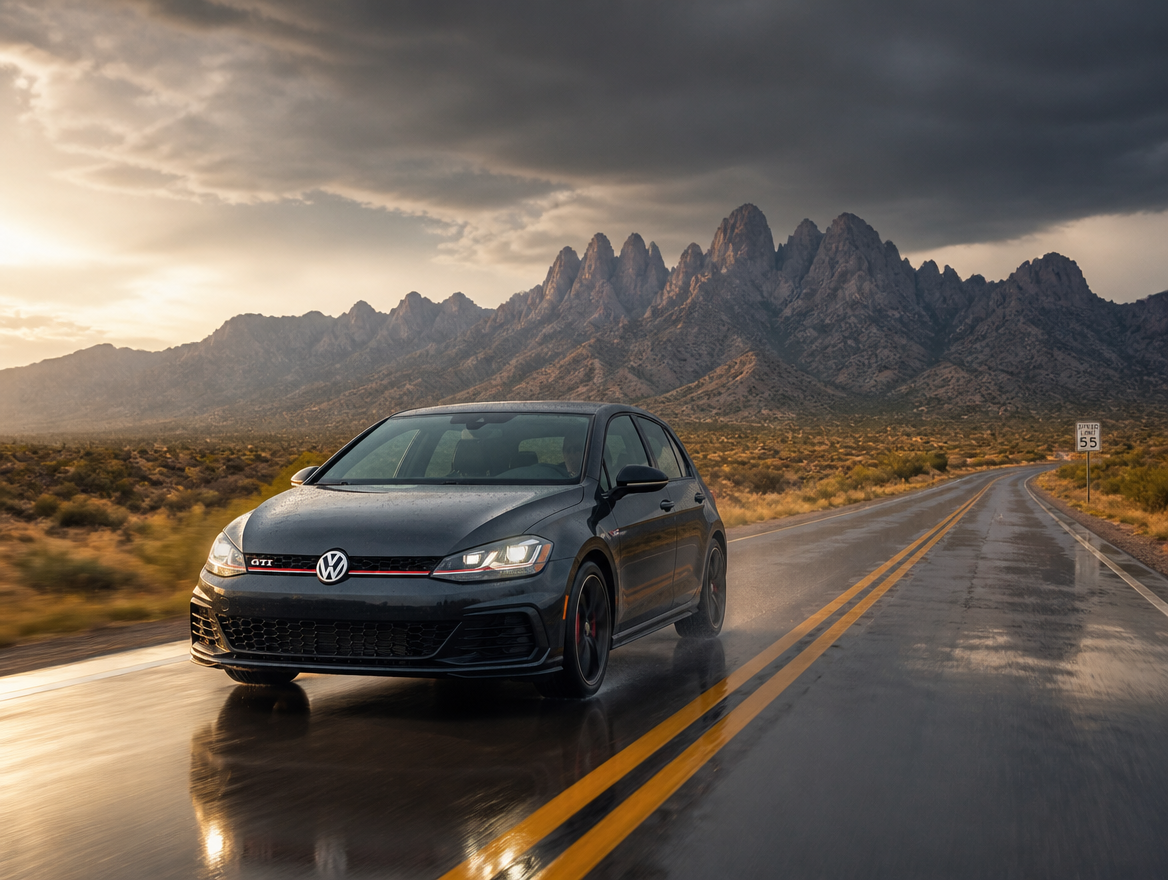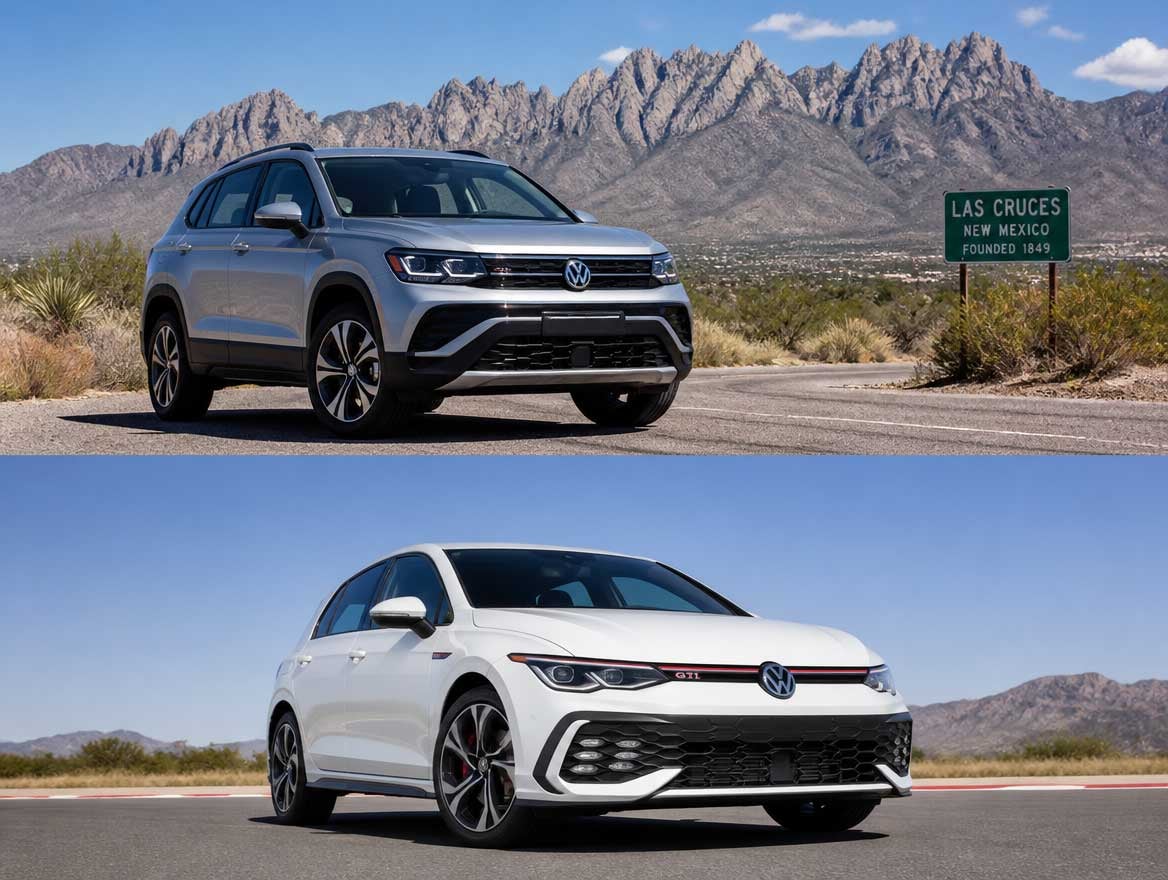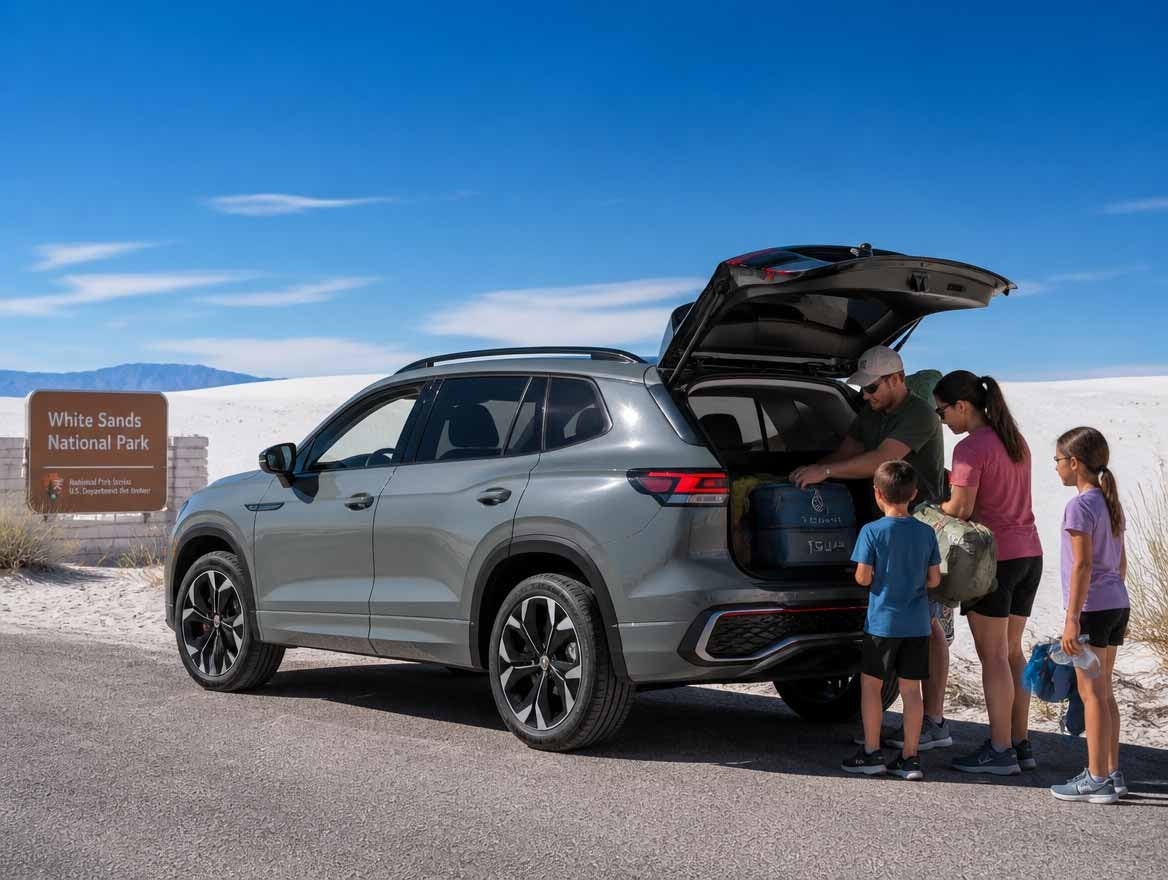

November in Las Cruces marks the tail end of monsoon season. Weeks of sun bake an oil-and-dust film into the asphalt on I-10, US-70, and every frontage road in the Mesilla Valley. An afternoon storm drops half an inch of rain in twenty minutes, that film floats, and a car that felt planted at 65 mph suddenly asks you a question you weren't expecting. That's when the front-wheel drive of the Golf GTI and the standard 4MOTION all-wheel drive of the Golf R stop being a spec-sheet debate. They become a real local question. For most Las Cruces routines, the Golf GTI handles southern New Mexico roads with full confidence. The Golf R earns its AWD premium when the desert decides to remind you it's still a desert. Golf GTI vs. Golf R on Desert Pavement: What Each Car Actually Does The 2026 Golf GTI and the 2026 Golf R share the same 2.0-liter turbocharged four-cylinder engine family, so on paper they read like siblings, but how each one puts power down is where they split, and on New Mexico roads that difference is the whole decision. Condition Golf GTI (FWD + VAQ LSD) Golf R (4MOTION AWD + torque vectoring) Practical edge Dry I-10 or I-25 at highway speed 241 hp, 273 lb-ft, 7-speed DSG. VAQ limited-slip differential balances front torque delivery 328 hp, 295 lb-ft, same transmission family. AWD keeps all four tires working Golf R on raw thrust; Golf GTI feels precise and lighter First rain on oil-glazed summer desert asphalt VAQ LSD reduces wheelspin at the front. Firm braking and straight-line entry matter 4MOTION shifts torque across all four wheels; rear torque vectoring can direct up to 100% of rear-axle torque to one rear wheel Golf R holds a clear margin here Standing water on flat desert highway ESC intervenes well. Golf GTI is about 200 lbs lighter, which aids quick directional changes AWD adds front-to-rear distribution on top of the same ESC suite Golf R, though the gap is smaller than its horsepower difference implies Dry canyon road heading toward the Organ Mountains Precise and communicative. Less weight through the turns More grip, more power, but heavier Driver preference; many find the Golf GTI more engaging NMSU campus, El Paso corridor daily commute EPA-estimated 24 city / 32 highway mpg EPA-estimated 22 city / 31 highway mpg Golf GTI wins on efficiency Las Cruces altitude (roughly 3,900 ft) and thin air Both are turbocharged. Turbo compensates for lower air density at our elevation Same turbo engine family, same compensation Essentially equal EPA figures are estimates. Actual fuel economy varies with driving conditions and habits. The Technique That Matters Most on Monsoon-Season Roads The technique that matters most on monsoon roads is nothing fancy, and it works even in the AWD Golf R, so just slow down the instant rain touches dry pavement, since the first minutes are the most treacherous stretch of any desert storm and no driveline erases that. The New Mexico Department of Transportation notes that storms here can intensify quickly, and because desert ground doesn't absorb water fast, pavement saturation happens with very little warning. The first ten minutes of any desert rainstorm are the worst. That oil-and-dust film that's been building since June goes slick before the rain rinses it away. The pavement turns on you fast. Here's the numbered sequence our team recommends for both cars on monsoon-season roads. Check conditions before leaving. NMDOT's nmroads.com and the 511 system update road closures and conditions in near-real time during active storm cells. Slow down the moment rain starts on dry pavement. Not after it's been raining for ten minutes. The first drops on a dry desert road are the most dangerous surface you'll encounter. Brake on the straight, not in the curve. Both the Golf GTI and Golf R give you a firm, communicative brake pedal. A straight-line brake preserves all four tires for cornering grip, and doing both at once asks too much of the contact patch. Watch every low-water crossing and arroyo crossing on US-70 east. Flash-flood runoff crosses the road faster than storm radar moves, and neither AWD nor FWD changes what happens once water is already moving across pavement. Use Comfort or Normal drive mode in standing water. Sport mode sharpens throttle response in a way that can upset traction when grip is marginal. Save Sport mode for the dry roads it's designed for. In the Golf GTI, the VAQ limited-slip differential is doing real work on these roads (not just padding the spec sheet). It redirects torque away from the front wheel that's beginning to slip, which is exactly the scenario rain-glazed desert asphalt throws at you. In the Golf R, the 4MOTION system's rear torque vectoring goes further. The technical documentation of Volkswagen confirms it can push up to 100% of rear-axle torque to a single rear wheel, which gives you a wider margin before a correction becomes necessary. There's a limit worth naming, though. AWD extends the threshold. It doesn't remove it. Both cars put rubber on the same pavement, and both reward the same fundamentals, reduced entry speed, early braking, and not asking the tires to do two jobs at once. AWD buys margin, nothing more. See our current new inventory to compare what's on the lot right now. If you want to talk through which car fits your actual drive, our financing team can walk through the numbers alongside the spec sheet. Altitude note from our team: Las Cruces sits at about 3,900 feet. Both cars are turbocharged, and the turbocharger compensates meaningfully for the thinner air at our elevation. A naturally-aspirated engine loses roughly 3% of its rated power for every 1,000 feet above sea level. A turbocharged engine like the EA888 in both of these cars recovers most of that loss by forcing air into the intake regardless. The altitude isn't why you'd choose one over the other here. Explore Financing Options The Recap: Right Car for the Right Southern New Mexico Driver If your routine is Las Cruces to El Paso on I-10, NMSU commutes, and the occasional weekend push north on I-25, the Golf GTI handles the high desert well all year, and it's the one that suits most of the driving here, with the Golf R held in reserve for the days the desert turns on you. It's more efficient, around 200 lbs lighter, and earns its keep on the dry roads that define most of our driving calendar. The standard 4MOTION AWD of the Golf R is genuinely valuable on the monsoon days when desert pavement goes from bone dry to glazed in five minutes, and for anyone who regularly runs north into higher elevations where conditions change faster. Both cars. Same platform. One fits the desert 340 days a year. The other fits all 365, with more power to spare. Schedule a pre-trip service check before your next long haul, or stop in and we'll put you in the right seat. Value Your Trade-In Sisbarro Volkswagen 1115 S Valley Dr, Las Cruces, NM 88005 (575) 319-9131